Showing posts with label #deepstate #law. Show all posts

Saturday, December 1, 2018

What’s Behind College-Educated, Suburban Women Flipping To Democrats


What’s Behind College-Educated, Suburban Women Flipping To Democrats


These women who reside in wealthy suburbs are an odd group. Sometimes they vote on the economy, but their loyalty to the pocketbook only goes so far.
NOVEMBER 7, 2018 By D.C. McAllister
Suburbs in Northern Virginia, New York, and New Jersey, among others across the nation, swung for the Democrats in the midterms, securing their control of the House. College-educated white women in these areas are being credited for the win, giving credence to the women’s movements that have dominated the headlines for the past two years. But this is only part of the story.
These women who reside in wealthy suburbs are an odd group. Sometimes they vote on the economy, but their loyalty to the pocketbook only goes so far. If they think their equality is threatened or health care won’t be available to everyone, they’ll abandon the economy in a heartbeat.
In the 2018 midterms, exit polling showed that voters’ main concern was health care—a whopping 40 percent. Immigration came in second at 23 percent, followed by the economy at 21 percent. Given the Republicans’ goal to whittle away at Obamacare and the notion that this will leave people without coverage or access to health care, it’s not surprising that these women weren’t inspired by the economy to keep the Republican agenda going.
Another issue that affects how many women vote is fear of inequality. For two years, activist groups and politicians beat the drum that the Republicans are threatening women’s rights. New Supreme Court justices could mean overturning Roe v. Wade. Free birth control might end with changes in health care. The Me Too movement created an environment of fear that men are predators, especially those in the Republican Party.
The rhetoric of Trump as sexual deviant in chief filled the pages of women’s magazines. Protests, pussy hats, celebrities wailing about the dehumanization of women even as they objectified themselves rained down on female voters, enlivening their allegiance to equality, even when it’s not actually being threatened.
These two issues, along with hatred of Trump, drove these women to vote blue. They despise Trump, and they always have. They voted for Hillary Clinton in 2016, 51 percent to Trump’s 45 percent. Some were Never-Trumper Republicans going for other candidates. They are, at the core, elitist. They didn’t like him then, and they don’t like him now.
Their feelings about Trump negated any objective judgment of his job performance or recognition that his policies and programs have benefited them greatly, including a strong economy and greater security for our nation. Emotionalism won the day.
In 2012, Mitt Romney won this group over Obama by six points because they had catapulted the economy to the top of their concerns. Many college-educated wealthy white women weren’t swayed by the war on women narrative at that time, nor were they concerned about health care as much, although it was still high on the list. They weren’t too worried; after all, Romney had instituted government health subsidies in Massachusetts.
Romney also soothed their elitist sensibilities. He was dignified. Their feelings could take a back seat to objective concerns because those fires weren’t stoked effectively enough to deter them. This wasn’t true for all women at that time. Some were swayed by the “binders full of women” attack, but not all.
This changed both in 2016 when they supported Clinton and even more significantly in 2018 when they flooded the polls to usher in a Democratic House majority. As reported by Ronald Brownstein just before the midterms, “Over two-thirds of college-educated white women, an unprecedented number, said they planned to vote Democratic for Congress, according to figures provided by CNN polling director Jennifer Agiesta.”
But they weren’t the only ones. College-educated suburban white men who were also offended by Trump’s behavior showed up to kick out Republicans. “Just over half of college-educated white men preferred Democrats in the survey,” Brownstein wrote. “That represents a sharp swing from their usual congressional voting behavior: Democrats haven’t won even 40% percent of college-educated white men in any congressional election since 2008, according to exit polls.”
This combination of elitist voters who can go Republican under some circumstances but will vote Democratic if they’re offended or worried about inequities made a difference in key suburbs.
Additionally, some of the congressional districts that had previously been favorable to Republicans because they were mostly rural—a stronghold for Trump—were redrawn to include wealthy suburbs, shifting the vote Democratic. As reported by USA Today, a fifth of the districts now under control of the Democrats had been redrawn in Pennsylvania.
The changes weren’t trivial: Democrats increased their share of the vote by an average of 20 percent in the districts they flipped in the Keystone State. The biggest change came in the 5th congressional district, a sprawling, mostly rural district in central Pennsylvania. Democrats won an anemic 33 percent there in 2016. In 2018, with the new boundaries in place, they won over 65 percent of the vote.
The suburban slaughter in the midterms, therefore, can be attributed to three things: motivated college-educated white women who put their fears about women’s issues and health care over economic and national security; both college-educated white women and men who are personally offended by Trump’s personality and rhetoric; and redrawing of district lines to include these groups to curb Republican advantages.
It’s uncertain if Trump can do anything to attract these voters. Probably not. That ship has likely sailed. The best he can do is shore up his base for the next election. The rest of us—conservative women in particular, who don’t vote by feelings and unfounded fears—need to step up. It falls on our shoulders to educate our suburban sisters about the role of government in their lives, the dangers of government-run health care, and the lies of feminism regarding “inequalities” in America.
Denise C. McAllister is a journalist based in Charlotte, North Carolina, and a senior contributor to The Federalist. Follow her on Twitter @McAllisterDen.

Friday, November 30, 2018

Democrats Aren’t Losing Faith In Our Constitutional System. They Just Don’t Like It


Many liberals see 'the system' as a way to achieve partisan goals, not as a set of idealistic values.

In the liberal imagination there are only four ways to lose elections — and none have to do with their increasingly leftist turn, their hysterics, or their one-dimensional identity politics. Democrats lose because of “gerrymandering,” “voter suppression” (sometimes known as “asking for ID”), Russian mind-control rays deployed by social media, and our antiquated and unfair Constitution.
The final one of these excuses is becoming increasingly popular among liberal pundits who continue to invent new crises to freak out about.
Take Vox’s Ezra Klein, a longtime champion of direct democracy: “I don’t think people are ready for the crisis that will follow if Democrats win the House popular vote but not the majority,” he tweeted before the midterms. “After Kavanaugh, Trump, Garland, Citizens United, Bush v. Gore, etc, the party is on the edge of losing faith in the system (and reasonably so).”
The “House popular vote” now joins the “national popular vote” and “Senate popular vote” (a particularly dishonest one considering California didn’t have a Republican on the ballot) as fictional gauges of governance used by Democrats who aren’t brave enough to say they oppose the fundamental anti-majoritarianism that girds the Constitution.
Otherwise, why would Democrats lose faith in a “system” that is doing exactly what was intended? The Constitution explicitly protects small states (and individuals) from national majorities. The argument for diffusing democracy and checking a strong federal government is laid out in The Federalist Papers and codified on an array of levels. This was done on purpose. It is the system.
I mean, do Democrats really believe the Electoral College was constructed to always correspond with the national vote? Do they believe that the signers of the Constitution were unaware that some states would be far bigger than others in the future? If the Founders didn’t want Virginia to dictate how people in Delaware lived in 1787, why would they want California to dictate how people in Wyoming live in 2018? If you don’t believe this kind of proportionality is a vital part of American governance, you don’t believe in American governance.
You can despise Brett Kavanaugh all you like, but why would Democrats lose faith in “the system” that saw Republicans follow directions laid out in the Constitution for confirming a Supreme Court nominee? Why would Democrats lose faith in “the system” that elected Donald Trump using the same Electoral College that every other president used? Why would they lose faith in a system that houses a Supreme Court that stops the other branches from banning political speech? When the Supreme Court affirmed the election of George W. Bush, it turned out to be the right call.
It’s because they see the system as a way to achieve partisan goals, not as a set of politically neutral idealistic values.
It’s not a civics problem, either. One hopes liberal activists like Ken Dilanian, who wonders “how much longer the American majority will tolerate being pushed around by a rural minority,” understand sixth-grade civics. New York Times columnist Paul Krugman surely knows that the Constitution doesn’t give “disproportionate weight” to smaller states. It intentionally gives all states the same weight in the Senate. Krugman only finds this idea “disproportionate” because it protects millions of Americans from the centralized coercive state that he envisions for them. The disproportionality he sees merely reflects his own concerns. It has nothing to do with the system.
Also, rural America doesn’t “bully” people like Dilanian. The federal government was never supposed to be this powerful. The non-“forward moving” America—those dummies Krugman would like to nanny from Washington—doesn’t very much care how Dilanian lives. He, on the other hand, has big plans for them.
It should be noted that these majoritarians throw millions Americans aside to make this argument. We don’t know how a national majority would vote. There are many millions of Republicans in New York and California who don’t involve themselves in the futility of state politics. There are more Republicans in California than there are in Wyoming.
But as you can see on Election Day, liberals have made “democracy”— a word mentioned zero times in the Constitution or the Declaration of Independence—into a sacramental rite. Getting more votes in an election outweighs the inherent rights of liberty that are laid out in the document. Unless, of course, that right happens to incidentally intersect with some advantageous partisan idea, like birthright citizenship; then Democrats become strict originalists. Everything else is up for discussion. Well, up for discussion now. It wasn’t a big topic for the hundred or so years Democrats were vastly overrepresented in the House.
The only reason these folks, who claim to want to save Constitution from Trump, see crisis in the “system” is that it fails to deliver for them politically. They’re not losing faith in the system. They just don’t like the system.
David Harsanyi is a Senior Editor at The Federalist. He is the author of the new book, First Freedom: A Ride Through America's Enduring History with the Gun, From the Revolution to Today. Follow him on Twitter.


The Lessons of the Failed Armistice of 1918


COMMENTARY BY


The First World War ended 100 years ago this month on Nov. 11, 1918, at 11 a.m. Nearly 20 million people had perished since the war began on July 28, 1914.
In early 1918, it looked as if the Central Powers—Austria-Hungary, Germany, Bulgaria, and the Ottoman Empire—would win.
Czarist Russia gave up in December 1917. Tens of thousands of German and Austrian soldiers were freed to redeploy to the Western Front and finish off the exhausted French and British armies.
The late-entering United States did not declare war on Germany and Austria-Hungary until April 1917. Six months later, America had still not begun to deploy troops in any great number.
Then, suddenly, everything changed. By summer 1918, hordes of American soldiers began arriving in France in unimaginable numbers of up to 10,000 doughboys a day. Anglo-American convoys began devastating German submarines. The German high command’s tactical blunders stalled the German offensives of spring 1918—the last chance before growing Allied numbers overran German lines.
>>> Watch Victor Davis Hanson’s talk at The Heritage Foundation on the lessons of World War I.
Nonetheless, World War I strangely ended with an armistice—with German troops still well inside France and Belgium. Revolution was brewing in German cities back home.
The three major Allied victors squabbled over peace terms. America’s idealist president, Woodrow Wilson, opposed an Allied invasion of German and Austria to occupy both countries and enforce their surrenders.
By the time the formal Versailles Peace Conference began in January 1919, millions of soldiers had gone home. German politicians and veterans were already blaming their capitulation on “stab-in-the-back” traitors and spreading the lie that their armies lost only because they ran out of supplies while on the verge of victory in enemy territory.
The Allied victors were in disarray. Wilson was idolized when he arrived in France for peace talks in December 1918—and was hated for being self-righteous when he left six months later.
The Treaty of Versailles proved a disaster, at once too harsh and too soft. Its terms were far less punitive than those the victorious Allies would later dictate to Germany after World War II. Earlier, Germany itself had demanded tougher concessions from a defeated France in 1871 and Russia in 1918.
In the end, the Allies proved unforgiving to a defeated Germany in the abstract, but not tough enough in the concrete.
One ironic result was that the victorious but exhausted Allies announced to the world that they never wished to go to war again. Meanwhile, the defeated and humiliated Germans seemed all too eager to fight again soon to overturn the verdict of 1918.
The consequence was a far bloodier war that followed just two decades later. Eventually, “the war to end all wars” was re-branded “World War I” after World War II engulfed the planet and wiped out some 60 million lives.
What can we learn from the failed armistice of 1918?
Keeping the peace is sometimes even more difficult than winning a war.
For an enemy to accept defeat, it must be forced to understand why it lost, suffer the consequences of its aggressions—and only then be shown magnanimity and given help to rebuild.
Losers of a war cannot pick and choose when to quit fighting in enemy territory.
Had the Allies continued their offensives in the fall of 1918 and invaded Germany, the peace that followed might have more closely resembled the unconditional surrender and agreements that ended World War II, leading to far more than just 20 years of subsequent European calm.
Deterrence prevents war.
Germany invaded Belgium in 1914 because it was convinced that Britain would not send enough troops to aid its overwhelmed ally, France. Germany also assumed that isolationist America would not intervene.
Unfortunately, the Allies of 1939 later repeated the errors of 1914, and the result was World War II.
Germany currently dominates Europe, just as it did in 1871, 1914, and 1939. European peace is maintained only when Germany channels its enormous energy and talents into economic, not military, dominance. Yet even today, on matters such as illegal immigration, overdue loans, Brexit, and trade surpluses, Germany tends to agitate its allies.
It is also always unwise to underestimate a peaceful America. The U.S. possesses an uncanny ability to mobilize, arm, and deploy. By the time America’s brief 19-month foray into war ended in November 1918, it had sent 2 million soldiers to Europe.
Had the armistice of November 1918 and the ensuing peace worked, perhaps we would still refer to a single “Great War” that put an end to world wars.
But because the peace failed, we now use Roman numerals to count world wars. And few believe that when the shooting stops, the war is necessarily over.

Sunday, November 25, 2018

Planned Parenthood Says It Puts Women First. This Missouri Clinic Proves Otherwise.


Monica Burke   The Daily Signal


Planned Parenthood claims to put women first, yet the atrocious health code violations found at a Missouri clinic earlier this month suggest otherwise.
The abortion giant was campaigning against newly proposed regulations on Missouri abortion clinics when state inspectors discovered a clinic in Columbia, Missouri, was already in violation of existing state regulations.
The clinic’s license was due to expire in October, so in anticipation, the state health department made its routine inspection of the facility in August. In that inspection, the department discovered disgusting and dangerous health violations such as moldy equipment and bodily fluid on recently used equipment.
The state informed Planned Parenthood of these health violations and expected the organization to correct them immediately.
Not only did the clinic fail to do so, it continued operating for over a month without correcting the violations.
When the state visited the clinic again on Sept. 26, 2018, they discoveredadditional violations. They found “bloody single-use plastic tubing attached to the machine’s glass suction canister that was never disposed of after the last abortion procedure on Sept. 21,” along with machines covered in mold and bodily fluid. The department also found rusty machines and exam room tables with chipped paint, making them impossible to sanitize.
Unfortunately, this is not the first time state officials have discovered intolerable conditions inside an abortion facility.
In 2013, Kermit Gosnell was found guilty of multiple counts of murder and involuntary manslaughter after authorities uncovered the disgusting conditions of his Philadelphia abortion facility in 2010. The gruesome detailsare the subject of a new film, “Gosnell: The Untold Story of America’s Most Prolific Serial Killer.”
After the unsanitary conditions of Gosnell’s clinic became public knowledge, abortion advocates claimed that he was a perfect example of why “women should have easier access to abortion so that they don’t have to seek care from an unqualified provider.”
It appears that Planned Parenthood never got the memo.
The Columbia Planned Parenthood was found operating under filthy conditions a mere eight years after the FBI discovered the harrowing conditions of Gosnell’s clinic. An dunfortunately, this is not an isolated incident.
Planned Parenthood found itself in hot water after authorities discovered similar conditions at its St. Louis location. This clinic was cited in 2009, 2013, 2015, and 2016 for highly unsanitary conditions and unsafe practices, totaling 210 health code violations in 39 different classes.
The violations included allowing two untrained employees to assist with surgical procedures, reusing single-dose medication vials for multiple patients, and failing to provide infection control training to staff.
Even where Planned Parenthood meets basic state-mandated requirements, they are providing fewer and fewer services to fewer and fewer women.
From 2015 to 2016, they provided fewer cancer screenings, breast examinations, HPV vaccinations, and prevention services to 100,000 fewer women at fewer locations than they did the year prior. From 2016 to 2017, prenatal services dipped too, down to 7,762 from 9,419 in 2015-2016.
By contrast, community health centers, which provide health care to women without entangling themselves in the abortion industry, outnumber Planned Parenthood locations 20 to 1. They also serve eight times more individuals that Planned Parenthood
However, one procedure for Planned Parenthood is on the rise: They performed several thousand more abortions in 2015-2016 than in the previous year: an uptick from 323,999 to 328,348. And the subsequent year they performed another 321,384 abortions, while only providing 3,889 adoption referrals, according to their own report.
That’s 83 abortions for every one adoption referral.
Despite plenty of rhetoric to the contrary, Planned Parenthood does not put the needs of women first, as their declining outreach and continued health care violations attest. Abortion remains Planned Parenthood’s bottom line.
These most recent health violations at Planned Parenthood in Columbia remind us that if we want quality health care for women, we must look at the abortion industry in the hard light of day.

Friday, November 23, 2018

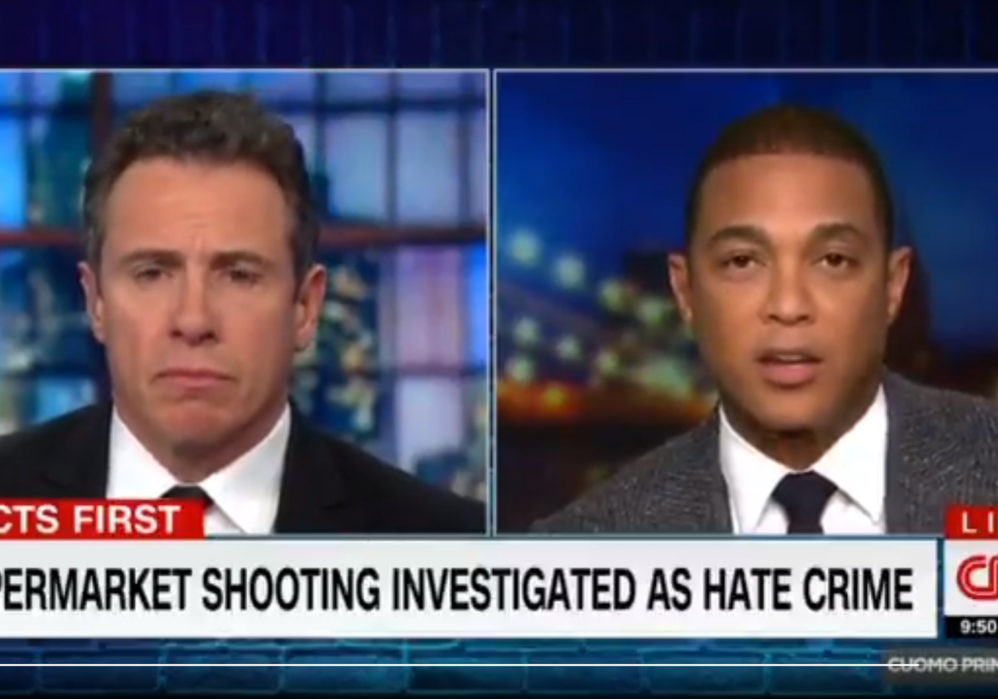
Don Lemon explained “the biggest terror threat in this country is white men,”


Don Lemon’s Attack On ‘White Men’ Isn’t Just Racist, It’s Incredibly Misleading

Don Lemon’s Attack On ‘White Men’ Isn’t Just Racist, It’s Incredibly Misleading


The notion that a person’s race predisposes him to act violently is unequivocally racist. It’s also easily debunked by a cursory reading of history. Then again, in today’s environment, where identity politics often strips Americans of their accomplishments, ideas, and actions so they can be judged by their melanin, it’s an unsurprising thing to hear.
“I keep trying to point out to people and, not to demonize any one group or any one ethnicity,” CNN host Don Lemon explained to his colleague Chris Cuomo, before telling him that “the biggest terror threat in this country is white men,” adding that “there is no travel ban on them”
This isn’t a new accusation. Now, Lemon is right that the vast majority of white shooters are men. He’s also correct that men are more violent than women. The majority of men in the United States are white. So some quick back-of-the-envelope calculation informs us that most shooters are probably going to be white men, just as most murderers in Arab countries are Arab men and most murderers in Asian countries are Asian men and so on.
A terrorist is a person who uses illegal violence and intimidation, especially against civilians, in the pursuit of political aims. This is not a movement. These white men have no palpable ideological or philosophical connection. They are not part of a concerted effort. They do not idolize the same people or subscribe to the same set of ideas. They do not share a worldview. Most of them do not kill in the name of “whiteness.” Few of them have a coherent message. I have as much to do with the Pittsburgh shooter as Lemon does.
The left-winger who yelled “This is for health care” before attempting to assassinate Republican congressional leadership in 2017 — somehow Lemon overlooked this event in his rant about angry white men — has nothing to do with the man who yelled “All Jews must die” when killing 11 innocent people at the Tree of Life synagogue in Pittsburgh. There is no nexus between the person threatening Republicans with ricin letters and the person threatening Democrats with pipe bombs.
Whether travel bans from terror-ravaged nations are effective or necessary is a worthy debate. But unlike Islamic terrorists, who destabilize entire regions, enslave entire communities, and in engage in decades-long campaigns against civilians, white men only share a hue. There is no infrastructure to assist them in their murders. There is no nation-state egging them on and abetting their efforts around the world. There are no big-money donors funding them. There is no movement recruiting them to kill, then rewarding their families afterwards.
Moreover, there is no rational or decent person in America, on either side of the partisan debate, justifying their actions. No matter how hard Democrats try to smear half the country as a party of budding brown-shirts, there is no political base for their violent ideology.
Unlike Islamic terrorism—which is propelled by a set of ideas and beliefs that has been adopted by people of every color in every area of the world—random white shooters do not generate massive numbers of refugees whom other nations are compelled to deal with. Governments don’t have to spend trillions of dollars to protect their citizens from this constant threat.
It’s also true Islamic radicals haven’t been as successful at targeting Americans lately because, after a highly effective day of carnage back in 2001, we became vigilant. The price has been high, in treasure, and sometimes in civil rights—another negative externality of Islamic terrorism.  Does Lemon demand a similar domestic effort aimed at white men for merely being white men?
Radical Islam is an ideology that’s quite popular in the world. White supremacy is a fringe belief that generates outsized coverage because of the horrible actions of some individuals and the political upside some in the media see in giving them attention. Stringing together every act of random violence in the nation—no matter how ambiguous, disconnected, and muddled the political motives of the perpetrators might be—does not make a terror problem. Even if it did, violence is not the monopoly of any group. In the past century, genocides have been perpetrated in Europe, Africa, and Asia.
Some people feed off the idea of drumming people they find objectionable out of public discourse. I’m not sure someone who uses hyperbole in the heat of a national debate deserves this fate. But in an environment where people are (ostensibly) thrown off their TV shows for a dumb statement about Halloween costumes, it seems rather extraordinary that others can unambiguously refer to “white men” as terrorists without repercussion.
David Harsanyi is a Senior Editor at The Federalist. He is the author of the new book,First Freedom: A Ride Through America's Enduring History with the Gun, From the Revolution to Today. Follow him on Twitter.