Showing posts with label @sbalich #tcot #Republican #GOP. Show all posts

Monday, December 10, 2018

How Democrats have become the party of vote fraud and stolen democracy


How Democrats have become the party of vote fraud and stolen democracy

Image: How Democrats have become the party of vote fraud and stolen democracy
(Natural News) The Democrats are now the party of vote fraud, and they have already stolen over a dozen House seats and at least one Senate seat. They’re still working to try to steal Florida through a massive “ballot factory” operation that continues to operate in blatant violation of both state and federal law.
Yet no one is stopping the Democrats from stealing elections.
The GOP still hasn’t figure out that Democrats will not voluntarily stop committing election fraud. They must be stopped by force (arrests).
While the GOP is playing by the rules, the lawless Left is cheating and thieving its way to electoral victory. And no one is being held accountable, which means the Dems have figured out they can do the exact same thing in 2020, too.
They are stealing our democracy, and they are getting away with it.
Hear my full podcast on this at Brighteon.com:
Read more at VoteFraud.news.

Sunday, December 9, 2018

The hidden warning in the 2018 midterms


The hidden warning in the 2018 midterms 


On the surface, last week's midterm elections really weren't awful. Sure, the left picked up a House majority, but the president's party routinely loses ground in Congress in midterm elections. Hell, even President Ronald Reagan saw the GOP lose yardage in the 1982 and 1986 midterms. Granted, having to say, "Speaker of the House Nancy Pelosi" is like saying "Sure, I'll have seconds of the stewed beets," but at least that "Beto" clown got his walking papers. Besides, the GOP can stock the federal judiciary with competent judges while the House Democrats spend the next two years arguing over whose name goes first on the latest bill to impeach President Donald Trump. Indeed, far from the anticipated hemorrhage, last week was more like a bad paper cut. Sure, it stings, but it won't even require stitches.


But that's on the surface. Beneath the veneer of acceptable losses, the midterms offered a warning that the GOP had bloody well better take seriously. While the infection of liberalism is slowly spreading to cover nearly the entire East Coast, and has essentially destroyed the opposite shore, it appears to be metastasizing to far-flung regions of the American body. Senator Ted Cruz defeated "Beto," but he hardly stomped him flat, and O'Rourke's campaign taught the Democrats that they can use their control of the media in concert with a monster spending campaign to great effect.

In Arizona, voters gave John McCain's already-shaky Republican seat to far-left Democrat Kyrsten Sinema. The changing demographics in the desert turned their backs on badass A-10 pilot Rep. Martha McSally to embrace a liberal who spent half her campaign discussing how much she hated them.

Deep in the heart of Dixie, the Democrats, who haven't dominated the landscape since they still had real KKK members on their roster, made noticeable noise. Although Stacey Abrams didn't win, she made a hell of a splash. Again, a "red" state turned purple by fawning media coverage working hand-in-glove with liberal cash. Considering Abrams on her own was a gaffe-prone curiosity, it's fair to say that her success essentially means Oprah Winfrey almost bought a governor's mansion.

In Florida, Representative Ron DeSantis barely outpointed socialist Mayor Andrew Gillum of Tallahassee in a gubernatorial contest which involved little more than Gillum using the media to paint DeSantis — and anyone else who mentioned his appalling corruption — as racist. In the Sunshine State's Senate battle, Phil Scott edged incumbent Bill Nelson in a race which I doubt Scott could have won without his own foundation as governor.

It's worth noting that both Florida and Georgia face junior varsity versions of the disputed presidential election of 2000. Much like that farce, Abrams, Nelson and Gillum are all engaged in brazen attempts to "find" enough votes to steal victory from the jaws of defeat. Perhaps learning their lesson from Al Gore's famous faceplant, the trio are using a combination of celebrity money and media misinformation to manipulate the situation to their advantage. Facts about bogus votes and imaginary attempts at voter suppression have faded behind celebrity- and reporter-spouted half-truths, outright lies and tangential character attacks on the Republicans. They've even begun floating the idea of "House" and "Senate popular votes" as being proof of a need to reduce American elections to pure popularity contests.

While the Democrats came uncomfortably close to the winner's circles in places in which they would formerly have been also-rans, they produced winners deep in their liberal redoubts who would have been on the other side of the Iron Curtain during the Cold War. Much like the lukewarm leftists who are spreading like mold into places like Texas, Florida, Georgia, Arizona and Virginia, the ones at the heart of the infection will look for ways to escape their urban confines. Given their innate authoritarianism, their "by any means necessary" mantra is clearly more than a metaphor.

The GOP may have come out ahead of short-term expectations last week, but their long-term expectations may need some tempering. If they — and, more importantly, conservatives as a whole — don't get their acts together, the next close calls will go the opposite way.

— Ben Crystal 

What’s the Deal with Yield?


What’s the Deal with Yield?
By Jason Williams
Written Dec. 07, 2018
If you’ve been paying even a little attention to the markets this week, you’ve likely heard the term “inverted yield curve.”
It seems to be tearing the world asunder with its rage. But what is it? And why is it so powerful?
Before I go any further, let’s get better acquainted with the topic on a lot of lips...
What Does That Even Mean?
The yield curve you’ve heard people talking about is the comparison of two U.S. Treasury bill rates.
When you compare the short-term rate to the long-term rate, the longer term is usually higher. That’s normal. People expect a higher return the longer their money is locked into an investment.
You expect to get paid a higher rate to loan your money out for 30 years than for one quarter.
Inversion is simply when the short-term rate gets bigger than the long-term one.
But when these forecasters of doom talk about the yield curve inverting, they’re not talking about the difference between one quarter and 30 years. They're not even comparing one year to 20 years...
They’re referring to the difference between the two-year Treasury rate and the 10-year Treasury rate. That’s a short term of two years and a long term of 10.
But the thing is, two years isn’t really short. And in the grand scheme of things, a decade ain’t that long.
That Depends on Your Definition
Even in the bond world — where most of the guys talking about the curve come from (and where I got my start at Morgan Stanley) — those aren’t the real rules...
When you’re talking fixed-income investments like bonds and Treasury bills, two years can count as short term. But so can three months. And that’s a lot closer to most investors’ understanding of a short holding period.
And 10 years? Well, that’s the outside edge of what they’d call a “medium-term” investment. Those last from five to 10 years.
At least that’s the definition when they’re explaining how to invest in fixed income.
But as soon as they see this difference between the two-year and the 10-year start to shrink, they go all Chicken Little and claim the sky is falling.
They don't explain how long their "short term" really is. And they change their own definition of what "long term" is to suit their narrative. 
And the tale they spin is a gloomy one for sure...
Inversion Brings Recession
They’ll tell you that when the two rates switch places, it’s a sign the markets are going to come crashing down.
And in a sense, they’re right...
When the short-term rate surpasses the long-term one, recessions typically follow. It's a sign that investors are nervous and demand a higher return from shorter investments. That means people are worried and getting ready for economic weakness.
But if you’re looking at the two-year rate and the 10-year rate, it gets a little tough to predict when the recession will happen.
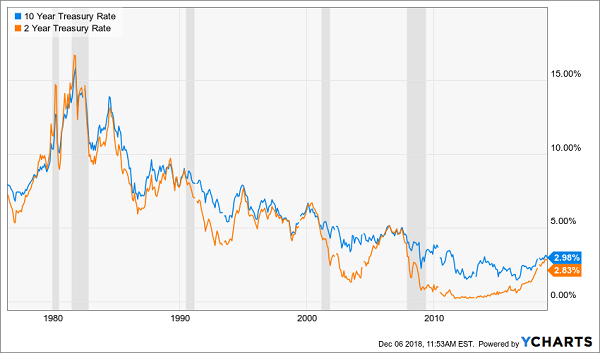
Here’s a chart of the two over the past 40 or so years. Recessions are in gray.
You’ll notice that the curve does, in fact, invert prior to recessions.
But you’ll also probably notice that sometimes it inverts right before one, like in the early 1980s. And sometimes it inverts years before one, like in the early 2000s. And sometimes it inverts and nothing happens, like in the mid-1990s.
Not a great forecasting tool if you ask me.
Building a Better Mousetrap
But I’m not saying the difference in short-term and long-term rates isn’t important to watch. I’m just saying you’ve got to use real short-term investments and real long-term ones, too.
To me, three months sounds a lot more like a short-term investment. Locking my money up for two years seems like a while — at least medium term.
So let’s take a look at the three-month Treasury rate versus that 10-year and see how it stacks up...
OK. I like that. We’re getting a little better. The curve inverts before the recessions. And it’s not throwing false positives anymore.
But it’s still hit or miss on the timing.
In the early 1990s, it’s a few years early. And it actually reverts to normal before the recession hits.
It pretty much nailed the dot-com bust. But it was early for the Great Recession. And it reverted to normal before the bad times really set in once again.
But I had a feeling that would be the case. Because 10 years isn’t really long term. Sure, it’s a long time. But when we talk about long-term investments, we’re talking decades, not years.
So, the 30-year Treasury rate might be a better indicator of what folks want from a real long-term investment.
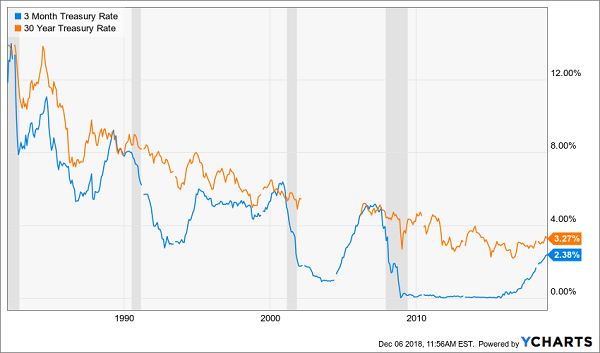
And when we replace the 10-year rate in that last chart, we get a much better look at short-term versus long-term borrowing and lending:
It’s still not perfect. But it’s closer than either of the others.
It stays inverted during the early 1980s turbulence. It inverts and stays that way a couple years prior to the early 1990s. It nails the dot-com crash and the Great Recession. But it still reverts before the 2008 crash.
And it’s still not throwing any false positives.
Like I said, it's not perfect. But I’d say that’s about the best we’re going to get as far as using historic Treasury rates to predict the future.
And as you can see by the numbers at the end, there’s still a good difference between the two rates — a solid 1%. They’ll call that 100 “basis points” in the bond world because that sounds bigger.
But it is a really big difference. And they need to drive that point home because 1% just doesn’t seem that massive.
That 1% tells me we’ve still got a ways to go until we need to worry about a stock market crash or an economic recession.

Saturday, December 8, 2018

Don’t Let Confusion and Fear Block Promising Genetic Therapy Treatments


Don’t Let Confusion and Fear Block Promising Genetic Therapy Treatments

Don’t Let Confusion and Fear Block Promising Genetic Therapy Treatments
Over the past three decades, I have consistently spoken about the enormous potential of biomedical breakthroughs that could solve many of our pressing public challenges. Because of this potential, I have advocated for increased public funding of basic scientific research and reforms at the Food and Drug Administration to speed up the process by which new treatments are available to patients.
One of the most exciting areas of biomedical science today is in genetic medicine, where we are just now seeing the public investment into sequencing the human genome bear fruit in the form of treatments to help patients overcome hereditary disorders.
On Tuesday, I had the pleasure of seeing first-hand just how extraordinary these new treatments are, when I attended the Sanford Lorraine Cross Award ceremony in Sioux Falls, South Dakota.
The award is different than most prizes for medical achievements. Rather than simply rewarding research which led – or could one day lead – to treatments, the Lorraine Cross Award honors doctors who take their research beyond the lab and take the risks to develop cutting edge cures that actually help patients today.
This focus on cures is a trademark of the philanthropic efforts of Denny Sanford, who has pledged almost $1 billion over the past 16 years to transform a small rural health system in South Dakota into a global health system of hospitals, research centers, and clinics. This system is helping transform the way health care is practiced around the world. In his honor, the health system adopted his name, Sanford Health.
In this inaugural year of the Sanford Lorraine Cross Award, all three of the finalists for the $1 million prize have developed gene therapy techniques which are being used to treat patients today.
As I learned about the incredible things these doctors were doing in this bold new field of medicine, it occurred to me that lack of funding and unnecessary bureaucracy are not the only things that can slow down the progress of developing new treatments. Unnecessary fear caused by confusion over what gene therapy is can also slow progress.
For example, last week, a researcher in China, He Jiankui, claimed that he had used a gene editing technique to confer HIV immunity on twin girl embryos, who were then successfully brought to term. The announcement was met with near universal global criticism, and the Chinese government responded by closing the doctor’s lab and opening an investigation that could result in criminal charges.
So, you see a $1 million prize and acclaim for gene therapy – versus criminal charges and outrage for gene editing. But what is the difference?
In the coming years, we will be hearing a lot more about genetic medicine. We will hear a lot of hope and optimism but also a lot of fear and calls for caution. To understand the awesome promise and peril of this extraordinary new field of medicine, it is worth examining the differences between the work which was honored yesterday in Sioux Falls and the work which was rightly condemned in China.
The technique – gene therapy vs. genome editing
First, there is a big difference between gene therapy and genome editing.
Gene therapy is treating an existing disease in an individual patient who is sick. As one of the Sanford Award nominees, Dr. Jim Wilson, who directs the Gene Therapy Program at the University of Pennsylvania – and whose work refining a gene therapy delivery system is the foundation upon which much of today’s gene therapy treatment is built – explained, “Gene therapy is really the ultimate treatment for patients that have disease due to single gene defects.”
Gene therapy only impacts somatic cells, which are non-reproductive. This means that changes in somatic cells will not be passed on to offspring. So, the treatment only impacts individual patients who give their consent to being treated. In the case of patients who are children, their parents give consent – a practice around which there is a long-established ethical consensus.
By contrast, the work done by the Chinese biologist involved manipulation of the genetic code of human embryos – a technique referred to as “embryo genome editing” (sometimes “germline cell editing.”) Germline cell editing alters reproductive cells. This means the changes will be passed on to future generations.
There is no ethical consensus in place that fully understands the implications of a set of parents giving ethical consent to treatment that will impact all future generations of a patient.
In addition, there is the huge ethical and scientific challenge of how to advance the science of genome editing without the destruction of human embryos.
We may very well see germline editing used in the future to cure disease. But that should only be done after much study and a consensus around these and other ethical issues is reached, which will take time.
In the meantime, we should continue to move forward with gene therapy of somatic cells.
The diseases being treated
Even within the field of somatic cell gene therapy, there are necessary guardrails in place.
Because the field is so new, gene therapy is currently only allowed for diseases which have no other cure or effective treatment.
For instance, one of the Sanford Lorraine Cross Award nominees, Dr. Brian Kaspar, is using gene therapy to change the course of type 1 spinal muscular atrophy, a devastating disease that destroys basic muscle function in babies and usually results in death by age 2. His treatment results in dramatic improvements in muscle function and survival.
Another pair of nominees, Drs. Jean Bennett and Katherine High, are using gene therapy to reverse an inherited form of blindness, which typically begins with a severe visual impairment during infancy that can continue to worsen over time. Their drug, Luxturna, was the first FDA approved gene therapy and has paved the way for many more breakthroughs.
Contrast these two intractable diseases being treated with gene therapy with what was done in China to make the children immune to HIV.
First, authorized gene therapy techniques are for conditions that already exist in a patient. The children treated at the embryonic stage in China were not HIV positive.
Second, avoiding HIV infection is relatively easy. And even if one contracts the virus, there are already a wide variety of effective treatments. An extraordinary combination of public and private research since the 1980s has turned being HIV positive from a death sentence into a manageable condition – if treatments are available.
There was simply no reason to use a technique as new, experimental, and fraught with ethical and medical peril as gene editing to prevent HIV infection. The risks greatly outweigh the reward.
With gene therapy on defective cells, we have a high degree of certainty about the medical impact of successful treatment – namely, normal function.
The work of the Chinese researcher was very different. He used a gene editing technique called CRISPR-Cas9 to shut down a gene called CCR5, which creates a protein necessary for HIV to enter cells. In other words, he shut down a gene that was functioning normally for humans in order to create an “artificial” resistance to the disease. However, while shutting down CCR5 may make one immune to HIV, we don’t know what other health impacts this will have. These two girls will need to be monitored for the rest of their lives to see how they develop.
Fixing a defect vs. human enhancement
Finally, the most fundamental difference between the type of work in genetic medicine honored by the Sanford Lorraine Cross Award and the work in China condemned around the world is that the former is treatment for genetic defects while the latter is the enhancement of human beings.
The prospect of human enhancement poses enormous ethical questions which strike at the core of how we think about equality – particularly in America.
The American ideal is not just equality under the law, it is also equal opportunity. Namely, that America should strive to be an open society, where people can achieve success through hard work and applying their God-given talents.
But what if talent was no longer exclusively God-given – and could be purchased? Human enhancement that can carry on through the generations could rapidly create a permanent and intractable divide between the wealthy and the rest of humanity because the rich would have both material advantages – and they would literally be born smarter, stronger, and healthier.
There may very well be a future in which genome editing is used medically, such as an effort to permanently eliminate certain recessive genetic disorders from humans. But that day should only come after we have figured out how to make the treatments available to all so that we advance together as a species – as we have with vaccinations for many diseases. Furthermore, we need to find a way to advance the science with the proper respect for human life in all its stages – including embryonic.
In the meantime, we should press forward with the kind of promising gene therapy techniques that were honored Tuesday in Sioux Falls. While these early stage gene therapies were for relatively rare conditions, they are setting the stage for gene therapy treatments for other inherited diseases, such as hemophilia and sickle cell anemia – diseases that impact many people. This is important foremost because of the number of patients it will help but also because of the public costs that are associated with these diseases.
We should all be excited and optimistic about the potential of gene therapy to save lives and make our world a better place.

Next superbug pandemic will kill “millions”


Health authorities warn next superbug pandemic will kill “millions” … and nations aren’t doing anything to stop it

Image: Health authorities warn next superbug pandemic will kill “millions” … and nations aren’t doing anything to stop it
(Natural News) When you think of a pandemic, global disease outbreaks like the Spanish flu that killed 50 million in the early 1900s or the more recent HIV/AIDS pandemic are what usually come to mind. However, some experts are warning that the next pandemic will come from an unexpected source – and it’s something that could largely be prevented if countries take the right precautions now.
The Organization for Economic Cooperation and Development (OECD), which is an advisor to the World Health Organization on initiatives for public health, has warned that public healthcare and spending face “disastrous consequences” if basic hospital hygiene is not improved and antibiotic use isn’t curbed.
The group said that superbugs could kill 2.4 million people by the year 2050; drug-resistant bacteria are already responsible for thousands of deaths, killing more than 33,000 Europeans in 2015 alone. The OECD said that the cost of treating these infections could climb to roughly $3.5 billion, on average, per year in each of the countries analyzed. The group said the countries are already spending around ten percent of their healthcare budget on antimicrobial-resistant bug treatment.
OECD public Health Leader Michele Cecchini said: “AMR costs more than the flu, more than HIV, more than tuberculosis. And it will cost even more if countries don’t put into place actions to tackle this problem.”
At the heart of this problem is the overuse of antibiotics, and we’re being hit from all angles. Doctors are prescribing antibiotics for viruses, which don’t respond to such medications, and they are also making their way into our bodies through agriculture and livestock products that are given such medications. As a result, many bacteria strains are developing that are able to resist the effects of antibiotics.
Resistance is already incredibly high in lower- and middle-income countries, with as much as 60 percent of the bacterial infections seen in places like Brazil, Russia and Indonesia already resistant to one or more antibiotics. The growth of these infections is expected to be 47 times faster in 2030.
Expert warn that even small kitchen cuts, minor surgeries and infections like pneumonia could turn deadly. The group also expressed concern about resistance to second-line and third-line antibiotics, which they say will swell by 70 percent by the year 2030. These types of antibiotics are supposed to be reserved for worst-case scenarios, but doctors are already using more of them when they should be using less, and that is seeing some of the best emergency options available right now taking a big hit.

How can this superbug pandemic be avoided?

The OECD says that the only way this superbug disaster could be prevented is by implementing widespread changes in healthcare immediately. For example, they stress that healthcare professionals need to make a better effort when it comes to hygiene in hospitals, washing hands regularly and instituting stricter safety rules.
Quicker testing to determine whether infections are viral or bacterial could also make a big difference as antibiotics are completely useless in the former case. Another approach that may be helpful is delayed prescriptions, which entails requiring patients to wait three days before they pick up antibiotic prescriptions. This is approximately the amount of time that a viral infection would take to run its course. In trials of this approach, two thirds of the patients who were given delayed antibiotic prescriptions never ended up collecting their medicine, which means that they did not take any needless antibiotics and exacerbate the problem.
According to Cecchini, such changes could cost as little as two dollars per person each year, paying for itself within a few months in addition to saving billions of dollars and millions of lives by mid-century.
Sources for this article include:

Friday, December 7, 2018

The Path Forward on Health Reform for Conservatives


Marie Fishpaw The Daily Signal


Last week’s election results show that health care is still a top concern for many Americans. Members of Congress must now decide how to move forward. Their task: providing a coherent answer to our national anxiety over health care.
Americans care, immensely, about health care. A Washington Post study found that health care was the most Googled subject in nearly every single county. Polls repeatedly showed that the No. 1 issue voters wanted their elected representatives to address was the high cost of health coverage.
Despite this dynamic, Republicans ran away from an issue that had been a source of political strength in recent years. Perhaps it was because of their failed attempt to repeal Obamacare, or perhaps it was because there was no consensus among them on how to protect individuals with pre-existing conditions. This gave the left an opening to attack conservatives as wanting to kill people with pre-existing conditions—an egregiously false slander.
Regardless, their silence allowed Democrats to retake the rhetorical high ground on health reform. Liberals used the opportunity to build the case for replacing Obamacare with even more government-run health care.
In other words, the same cadre that drove up health costs and cut health care choices for 15 million people by breaking the private market now want to do the same thing for the rest of the country.
We can expect repeated efforts to push various forms of a government-run health system over the next two years. More than half of the House Democrats have signed onto a bill implementing this vision, as have 16 senators—including some often mentioned as potential presidential candidates.
But new federal government health schemes will not bring better, more affordable care to most Americans. Most would lose their current coverage—be it from their employer, union, or school—because it would become illegal. Nor could individuals or families purchase coverage outside of the government’s system.
Make no mistake: Under these schemes, the government decides what gets covered, who gets what care, and when. It would reduce access to care and dramatically increase wait times. In Canada, where health care is government-run, some will wait nearly three months to get a simple MRI.
Politicians who reject that approach must also reject half-way measures like “public options” and new federal reinsurance programs—all of which double down on the problems we have today and would expand the government’s role, driving up costs and reducing choice even further.
But politicians need to do more than simply oppose. Instead, they must finally offer a compelling alternative for all Americans, including those with pre-existing conditions. Exit polls show that Americans care deeply about how this country will protect people with pre-existing conditions and make sure they have the care they need.
Fortunately, conservative policy experts, working together at the national, state, and grassroots levels, have developed just such an alternative.
The Health Care Choice Proposal would make coverage far more affordable—lowering premiums by up to 32 percent, according to the Center for Health and Economy in research commissioned by The Heritage Foundation. Moreover, it would ensure that everyone could access a quality, private coverage arrangement of their choice.
The proposal relies on a fresh framework. Patients would be able to choose the coverage arrangement that works best for them from a wide array of options, including direct primary care, short-term limited duration plans, catastrophic coverage, or “gold-plated Cadillac” coverage. Everyone who gets a government subsidy for health care would get new control over those dollars and be able to apply them to a plan of their choice rather than the one a bureaucrat picks for them.
The proposal also would do away with Obamacare’s flawed subsidy structure in which insurance companies receive taxpayer subsidies, dollar for dollar, as they raise prices. Instead, federal funds would be placed on a budget and sent to states to help people access a quality private coverage arrangement of their choice—including the vulnerable poor and sick.
Data show that this proposal builds on a promising emerging trend. A Heritage Foundation study found that, when states have been given even a little bit of freedom from Obamacare’s mandates, they’ve been able to lower projected 2019 premiums—in one state by up to 43 percent—while still ensuring that the sick retain access to care. And they’re able to do all this without new federal money or micromanagement of the market.
Ninety leading conservatives have already endorsed the Health Care Choice Proposal as the path forward on health reform. This is a sharp change from 2017, when Congress fell short and failed to unify behind an Obamacare replacement plan. Our families cannot afford continued failure.
That’s why conservatives created a strong framework on which to build. Efforts to refine and improve this proposal can and will continue. But even in its current form, it offers a way to help Americans suffering under high health costs and fewer choices, a clear alternative to the progressive agenda, and a serious plan to alleviate the health care anxiety in the country.

Special counsel witness says he expects to be charged in Mueller probe


  • The former Infowars Washington bureau chief, who recently testified before a federal grand jury in special counsel Robert Mueller’s probe into Russian interference in the 2016 U.S. presidential election, tells ABC News that after two months of closed-door talks with investigators, the special counsel has now indicated he will be charged within a matter of days.

    Corsi is one of more than a dozen individuals associated with political operative Roger Stone -- a longtime and close ally of President Donald Trump -- who have been contacted by the special counsel. The witnesses, many of whom have appeared before the grand jury impaneled by Mueller’s team, have told ABC News they were asked about Stone’s dealings during the 2016 election and what if any contact he may have had with Wikileaks founder Julian Assange through an intermediary, which Stone denies.“I don’t know what they’re going to charge me with,” said Jerome Corsi in an interview with ABC News on Monday. “I think my only crime was that I support Donald Trump. That's my crime, and now I'm going to go to prison for the rest of my life for cooperating with them,” he later added.
    Much remains unknown about Mueller’s interest in Stone. But Corsi has emerged as a central figure of interest to Mueller as he builds his case, sources confirm to ABC News. Corsi, who Stone told ABC News he has known for years, has frequently appeared with Stone on-air for Infowars, where Stone currently serves as a contributor.
    Corsi described his experience with the investigation as “a horror show” and “a nightmare,” telling ABC News the special counsel’s probe, “Is an inquisition worthy of the KGB or the Gestapo. I feel like I've been through an interrogation session in North Korea in the Korean war.”
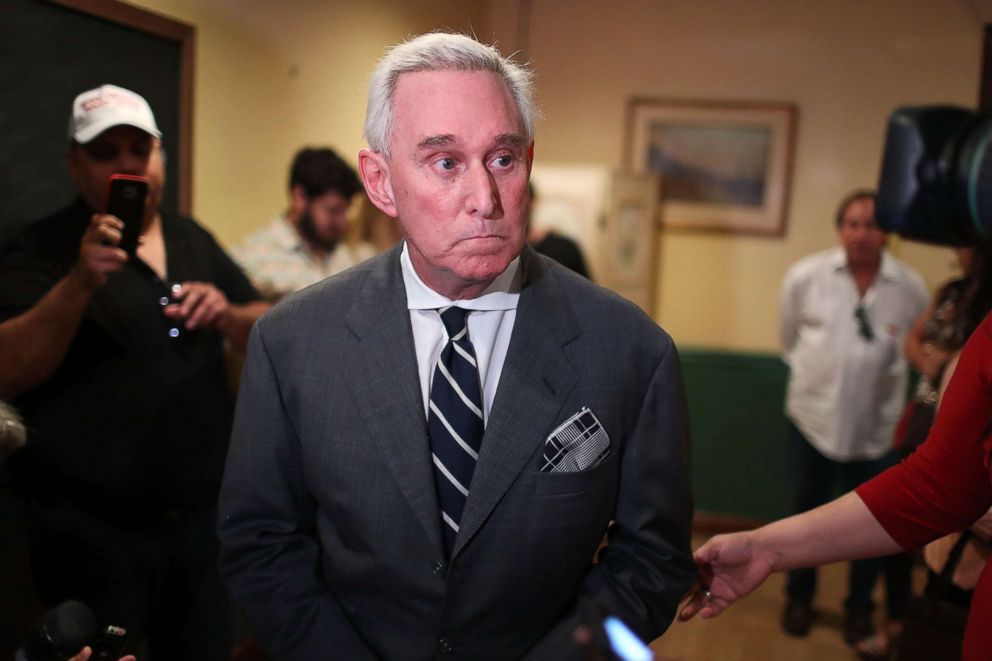
    PHOTO: Roger Stone, a longtime political adviser and friend to President Donald Trump, speaks during a visit to the Womens Republican Club of Miami, May 22, 2017, in Coral Gables, Florida.Joe Raedle/Getty Images
    Roger Stone, a longtime political adviser and friend to President Donald Trump, speaks during a visit to the Women's Republican Club of Miami, May 22, 2017, in Coral Gables, Florida.more +
    The special counsel’s office declined to comment on Corsi’s remarks to ABC News.
    In recent weeks, ABC News reported that Corsi returned to Washington, D.C., again for more closed-door meetings with special counsel investigators, and was scheduled to make a second appearance before the federal grand jury in the probe. However, Corsi’s second grand jury testimony was ultimately canceled, and Corsi says prosecutors with the special counsel’s office told his attorney to expect forthcoming charges.
    Reached by ABC News on Monday, Corsi's lawyer, David Gray, declined to comment on the matter.
    Shortly after his interview with ABC News, Corsi hosted a live stream on his YouTube page in which he reiterated his expectation to be indicted, telling supporters; “I fully anticipate in the next few days to be indicted by Mueller.”
    Mueller’s interest in Corsi is believed to stem from his alleged early discussions about efforts to unearth then-candidate Hillary Clinton’s emails. The special counsel has evidence that suggests Corsi may have had advance knowledge that the email account of Clinton’s campaign manager, John Podesta, had been hacked and that WikiLeaks had obtained a trove of damning emails from it, two sources with direct knowledge of the matter told ABC News.
    Corsi’s account to ABC News of his time spent with investigators also identifies Wikileaks’ release of Podesta’s hacked emails as key to the special counsel’s inquiry of him.
    In response to ABC News’ interview with Corsi, Stone defended Corsi as “a man who has been squeezed hard but refuses to do anything but tell the truth,” and called into question both his and Corsi’s alleged connections to Wikileaks.
    “They seem to think you know that I knew in advance what Assange was going to do; I'm not going to go into details at this point, but that was the basis of it,” said Corsi. “And as far as I can recall, I had no contact with Assange. And that didn't seem to satisfy them.”
    Corsi said he was first approached in late August by FBI agents at his home in New Jersey, who presented him with a subpoena to testify before Mueller’s grand jury. Corsi added that over the last two months, he’s spent 40 hours with investigators over the course of six meetings, which he says have included special counsel prosecutors and an FBI agent.
    After the subpoena was served, Corsi said that he decided to cooperate with the special counsel’s office.
    “I had two computers that I used, I handed them both over, a time machine that recorded all the emails in my computer in a contemporaneous state 2016 -- completely unaltered,” he said. “I worked with the FBI at Quantico so that they could easily recover all my tweets and my Google account. My Google account they could see every place I've been, every click I've made, everything Google records.”
    After the FBI’s visit, Corsi said, he and his attorney agreed to cooperate with the special counsel’s office and proffered to meet with special counsel investigators to answer their questions. “They have everything: Electronic surveillance -- everything electronic probably that I ever did in my life if they wanted -- every credit card, every phone call, every email, and I turned it all over to them as well,” he added.
    Declining to give specific details on the matter until Corsi learns what he’s potentially charged with, he said the special counsel initially wanted him as a witness and told him he had not committed any crimes.
    “And then it blows apart...at the end of two months...this deteriorates, and after a while, my mind became mush,” he said. “And every time I'm scared to death.”
    Corsi said that from there, after two months of questioning, things deteriorated between him and investigators.
    “They make it sound like it all fell apart and they were constantly pressing me on did I have a contact with Assange, and -- to the best of my knowledge -- I never had a contact with Assange,” Corsi said to ABC News. “And they just couldn't believe that because they said I seemed to know too much about what Assange was going to do. And I said you know that's what I do in my business: I try to connect the dots.”
    While Corsi is not a widely-recognized figure, his handiwork in the political arena has at times become very well known. He has served as the pioneer of several enduring political smear campaigns during national campaigns throughout the 2000s.
    Corsi’s most penetrating smear campaign is the same one that helped forge his bond with Trump. He is widely considered one of the early promoters of the so-called “birther” movement, which pursued the idea that former President Barack Obama was born in Kenya, not in America. The theory was debunked and widely denounced as baseless, racist vitriol. Corsi and Trump have long been blasted for not walking back their claims even after Obama produced his long-form birth certificate. In fact, it was only in the final stretch of his successful 2016 presidential bid that Trump finally acknowledged that Obama was born in the U.S.
    Corsi has also been cited as one of the architects of a 2004 effort to bring then-Democratic presidential candidate Sen. John Kerry’s war record into question through a 527 political organization called Swift Boat Veterans for Truth. The group attempted to cast doubt on Kerry’s Vietnam War record and question the injuries he sustained when he earned decorations that include a Bronze Star, a Silver Star, and three Purple Hearts.
    Corsi claims that his work is part of the reason he believes investigators are probing him.
    “My conclusion was as much as they say they want only the truth, I believe that they have a narrative and they’re looking for fast facts to fit their narrative,” he said. “I've written 20 books since 2004 and I have reason to believe...that this is payback for those books.”
    Shortly after Trump’s inauguration, when Corsi joined the controversial conspiracy theorist Alex Jones’ right-wing outlet, Infowars, Jones reportedly boasted that Corsi “had a history” with Trump, and that the two had been acquainted for “40-plus years.”
    When ABC News asked if he would be open to making a plea deal with the special counsel’s office should they charge him in coming days, Corsi replied, “What’s there to be a plea deal with?” and expressed his suspicions about the possible charges investigators may claim against him.
    “They said I didn't commit any crimes. I can't remember all my emails I can't remember all my phone calls, [and] I tell them that. It's impossible; it's a perjury trap from the moment you get going,” Corsi said.
    “My crime is that I didn't tell them what they wanted to hear. They won't believe it, but this is the most frightening experience of my lifetime. I'm being punished for trying to cooperate with them in a game that I was set to lose,” he added. “I couldn't win this game...it wasn't a game; I was trying to tell them the truth. But you forget that somebody was in a meeting and you lied to them.”