Monday, April 2, 2018

Trump declares 'NO MORE' DACA deal after report of caravan with Central Americans heading to US


Trump declares 'NO MORE' DACA deal after report of caravan with Central Americans heading to US


President Trump declared on Sunday the deal for the Obama-era DACA program was “NO MORE” and called for "tough" immigration reform after a report stated a caravan carrying more than 1,000 people from Central America is traveling through Mexico and to the United States in hopes of entering the states illegally or by asking for asylum. 
Trump, who has vowed to end catch and release, tweeted Sunday morning that Republicans need to take the "nuclear option" when passing tougher immigration laws.
The president had given Congress six months to pass legislation enshrining the Deferred Action for Childhood Arrivals program (DACA), which protects about 800,000 young immigrants brought to country illegally as children from deportation.
“Border Patrol Agents are not allowed to properly do their job at the Border because of ridiculous liberal (Democrat) laws like Catch & Release. Getting more dangerous. 'Caravans' coming. Republicans must go to Nuclear Option to pass tough laws NOW. NO MORE DACA DEAL!” the president tweeted.
The caravan the president was likely referring to was first reported by BuzzFeed News on Friday. Organized by Pueblos Sin Fronteras, or People Without Borders, the caravan traveled through Mexico without authorization last week, according to the report. Officials in Mexico have not attempted to stop the migrants, about 80 percent of them from Honduras. The group’s intent is to provide those people a safe way to travel to the U.S.
Hundreds of Central Americans attend a mass before they begin a Via Crucis on Palm Sunday from the southern state of Mexico to the center and north of the country, demanding respect for their human rights, asylum and reports of violence in their countries in Tapachula, Mexico March 25, 2018. REUTERS/Jose Torres NO RESALES. NO ARCHIVES. - RC1DDBDE3160
Hundreds of Central Americans marching from the southern state of Mexico to the center and north of the country.  (Reuters)
National Border Patrol Council (NBPC) union chief Brandon Judd told “Fox & Friends” on Sunday that the migrants are riding on the benefit of catch and release, when illegal immigrants are detained in the U.S. and released while they await for their court hearings.  
Trump also threatened to pull out of the free trade agreement with Mexico unless the country did more to stop the flow of illegal immigrants entering the U.S. The U.S., Canada and Mexico are currently renegotiating the North American Free Trade Agreement at Trump's insistence.
“Mexico is doing very little, if not NOTHING, at stopping people from flowing into Mexico through their Southern Border, and then into the U.S. They laugh at our dumb immigration laws. They must stop the big drug and people flows, or I will stop their cash cow, NAFTA. NEED WALL!” he tweeted.
“These big flows of people are all trying to take advantage of DACA. They want in on the act!” he added.
Trump also spoke about DACA and Mexico before attending Easter services at Episcopal church near his home in Palm Beach, Fla.
"Mexico has got to help us at the border," Trump told reporters as he held his wife, Melania's, hand. "If they're not going to help us at the border, it's a very sad thing between our two countries."
Organizers believe about two-thirds of the people in the caravan are planning to enter the U.S. illegally or by asking for protection, according to BuzzFeed. The caravan does not give the migrants the guarantee they will enter the U.S. and uses any form of transportation necessary to make it to the border. Most of the people are reportedly fleeing poverty and political unrest from their home country.
Hundreds of Central Americans attend a mass before they begin a Via Crucis on Palm Sunday from the southern state of Mexico to the center and north of the country, demanding respect for their human rights, asylum and reports of violence in their countries in Tapachula, Mexico March 25, 2018. REUTERS/Jose Torres NO RESALES. NO ARCHIVES. - RC194E1C4900
Hundreds of Central Americans attend a mass before they begin a Via Crucis on Palm Sunday from the southern state of Mexico to the center and north of the country, demanding respect for their human rights, asylum and reports of violence in their countries in Tapachula, Mexico March 25, 2018.  (REUTERS/Jose Torres)
“First off, you have got a Mexican government entity that is assisting these individuals that are coming up to the United States,” Judd told “Fox & Friends.” “These individuals do not have passports or legal documents to be in Mexico, yet you got an agency that’s helping them get to our [U.S.] border.”
Judd said border patrol agents do not have the ability to stop the migrants at the border even if they only step one foot on U.S. soil. 
“Once they [the migrants] enter the country, even if we [border patrol agents] are standing at the border with our hands out saying, ‘Don’t enter, don’t enter,’ all they have to do is cross one foot into the border and we have to take them into custody,” Judd said. “If they ask for asylum or say I fear to go back to my country, then we have to process them under ‘credible fear’ which allows them to be released into our country.”
It’s unclear when the hundreds of migrants will be arriving at the U.S. border. Some of those who are traveling with the caravan are planning to stay in Mexico.  
The Associated Press contributed to this report. 

When toting guns in high school was cool


When toting guns in high school was cool

New York City high schoolers used to pack heat as often as they packed lunch.
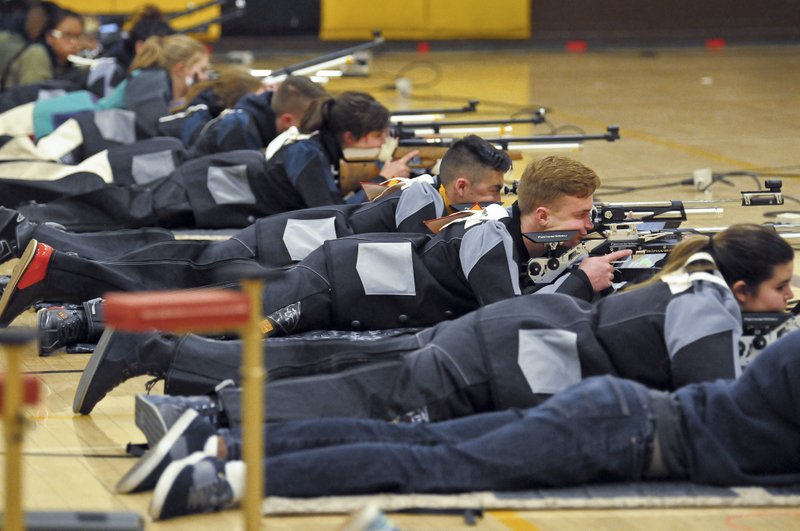
This month, more than 100,000 city public school kids walked out to protest gun violence — but last century some students attended class armed with their rifles and practiced shooting on school grounds.
Many of the city’s public high schools had shooting clubs and a few even had gun ranges on their premises, according to accounts from the Department of Education and others.
There were at least three shooting ranges in public schools, the DOE said, including Curtis HS on Staten Island and Erasmus Hall HS in Brooklyn.
Another inside Far Rockaway HS in Queens, which closed in 2011, is shown in a black-and-white archival photo from May 1929 displaying a compartmentalized gun range with at least five windows to shoot from and cranks for students to pull the targets back and forth.
“To accommodate the kids, they even made them these little pull-out benches they can kneel on to shoot from that position or even lie down to shoot,” said Darren Leung, owner of Westside Rifle & Pistol Range in Chelsea, describing the equipment seen in the 89-year-old photo. “What an excellent design.”
Shooting clubs were popular in many schools, even if they didn’t have gun ranges.
Modal Trigger
Rifle range at Far Rockaway High SchoolA. J. Hickey/NYC Dept. of Records
Members of the shooting club at Tottenville HS on Staten Island would bring their rifles to school, but the club would travel a few miles to Perth Amboy, NJ to practice, according to one alum who attended in the 1940s.
“Even in New York City, virtually every public high school had a shooting club up until 1969,” gun-rights advocate and academic John Lott Jr. wrote in his 2003 book, “The Bias Against Guns.”
“It was common for high school students to take their guns with them to school on the subways in the morning and turn them over to their home-room teacher or the gym coach so the heavy guns would simply be out of the way. After school, students would pick up their guns when it was time for practice.”
The DOE doesn’t know exactly how many shooting clubs or gun ranges city schools had or when they were shut down.
Steve Balich explaining the problem of Gun violence in schools stems from a culture with a lack of respect for life. 


Sunday, April 1, 2018

Tucker Finally Had Enough of David Hogg, Took Him Down on National TV


In the wake of the Parkland shooting, the left has waged a proxy war on guns. And they’ve done so with child soldiers.
The most prominent of these has been David Hogg. If you’ve been anywhere near a TV, computer, smartphone or newspaper these past few weeks, you’ve undoubtedly seen Hogg, whose only compelling argument is that he survived the shooting at Marjory Stoneman Douglas High School and that you need to listen to him.
Whenever someone calls Hogg out on the fact that being a shooting survivor does not make one an expert on constitutional law, gun policy, school security, or really anything other than your own experience, they’re called insensitive — almost as if the left is hiding behind these child soldiers, using them as human shields.
On his Friday show, in an analysis of the rhetoric of David Hogg and Emma Gonzalez — two of the most vocal anti-gun Stoneman Douglas students — Carlson called them extremists who are “definitely not fit to be making policy for the rest of us.”


“A handful of teens from Stoneman Douglas High School in Florida, they have a right to their views, obviously. This is a given,” Carlson said.
“But the rest of us also have rights including the right to assess what they are saying and decide whether it ought to become law to which we are subject. These are not religious figures; we are not the faithful. We’re all citizens here. Let’s take a look at what they are saying and decide if it’s a good idea or not.”
Carlson went on to play Hogg’s infamous profanity-imbued interview with The Outline.
“Sell more guns, murder more children, get re-elected. That is David Hogg’s view of the other side of the debate,” Carlson said. “Emma Gonzalez, meanwhile, another celebrated survivor the shooting basically agrees with that. She recently said in a speech, quote, ‘I don’t really care what people who defend the Second Amendment have to say.’

“Let’s take this seriously,” Carlson continued. “If you honestly don’t care what the people who disagree with you think, if you believe they want to ‘murder more children,’ who are you?
“Well, you’re angry. You’re definitely not fit to be making policy for the rest of us. You are by definition an extremist. You should not have power if you really believe anyone who disagrees with you is evil and wants to kill the innocent.”
He also went after those who want to hide behind Hogg and Gonzalez, or attack him for having the temerity to look at their rhetoric.
“Wait, you say, ‘Why are you picking on David Hogg? He’s only a kid, he shouldn’t be held to adult standards of reasoning or think critically about the consequences of what he espouses.’
“Well, yeah, exactly. He is a kid,” Carlson continued. “He has just been through unspeakable tragedy. And that’s why adults shouldn’t be using him or his friends to push their agendas to the rest of us.”
“This kid who saw unspeakable tragedy, he saw his classmates killed. And that’s exactly why he shouldn’t be involved in formulating a response to it. Because he is a kid. So you can’t simultaneously argue that you need to shut up and listen to him and if you don’t you’re bad which is what the left is arguing and that we shouldn’t take what he says seriously or literally.
“You kind of have to choose one,” Carlson concluded. “I’m happy to choose the first one.”

NRA gave $7,000,000 to Illinois Schools


AP finds the NRA gave $7 million to hundreds of schools

The National Rifle Association has dramatically increased its funding to schools in recent years amid a national debate over guns and school violence, an Associated Press analysis of tax records has found. But few say they plan to give up the money in the aftermath of the latest mass shooting.
The AP analysis of the NRA Foundation’s public tax records finds that about 500 schools received more than $7.3 million from 2010 through 2016, mostly through competitive grants meant to promote shooting sports. The grants have gone to an array of school programs, including the Junior Reserve Officer Training Corps, rifle teams, hunting safety courses and agriculture clubs.
In some ways, the grant distribution reflects the nation’s deep political divide over guns. Nearly three-quarters of the schools that received grants are in counties that voted for President Donald Trump in the 2016 election, while a quarter are in counties that voted for Democrat Hillary Clinton, according to the AP analysis. Most are in medium-sized counties or rural areas, with few near major cities.
California received the most in school grants, more than $1 million, while Florida was a close second.
Florida’s Broward County school district is believed to be the first to stop accepting NRA money after a gunman killed 17 people at one of its schools Feb. 14. The teen charged in the shooting had been on a school rifle team that received NRA funding. School officials announced the change Tuesday but declined to comment further.
Denver Public Schools followed on Thursday, saying it won’t pursue NRA grants in the future and will turn down several that were to be awarded this year. But officials in many other districts say they have no plans to back away.
“Whatever I think of the NRA, they’re providing legitimate educational services,” said Billy Townsend, a school board member in Florida’s Polk County district, whose JROTC programs received $33,000, primarily to buy air rifles. “If the NRA wanted to provide air rifles for our ROTC folks in the future, I wouldn’t have a problem with that.”
The grants awarded to schools are just a small share of the $61 million the NRA Foundation has given to a variety of local groups since 2010. But it has grown rapidly, increasing nearly fourfold from 2010 to 2014 in what some opponents say is a thinly veiled attempt to recruit the next generation of NRA members.
The NRA Foundation did not return calls seeking comment.
Annual reports from the pro-gun group say its grant program was started in 1992 and raises money through local Friends of NRA chapters. It says half the proceeds from local fundraisers go to local grants and half goes to the national organization. Tax records show roughly $19 million in grants going to the group’s Virginia headquarters in 2015 and in 2016.
Besides schools, other typical recipients include 4-H groups, which have received $12.2 million since 2010, Boy Scout troops and councils, which received $4 million, and private gun clubs. Overall, about half the grants go to programs directed at youth.
Grant funding to schools rose sharply in the years after the 2012 shooting at Connecticut’s Sandy Hook Elementary School, fueled in part by a new grant program the NRA unrolled to help schools make safety improvements. Three districts received safety grants totaling $189,000 in 2014, tax records show, but none appears to have been awarded since then.
Nearly half of the 773 overall school grants have gone to JROTC programs, which put students through a basic military curriculum and offer an array of small competitive clubs, like the rifle team at Broward’s Marjory Stoneman Douglas High School. But JROTC leaders say few students ultimately enlist in the military, and the primary goal is to teach students skills like discipline and leadership.
“The safety that we’re teaching, the good citizenship that we’re teaching here, those are the things you don’t hear about,” said Gunnery Sgt. Jim Flores, a JROTC instructor at Cibola High School in Albuquerque, New Mexico. “The majority of people walk out of here awesome young men and women, respectful of authority, things of that nature. Not so much little tin soldiers.”
In some parts of the country, shooting clubs draw the same sort of following as any school sport. Bill Nolte, superintendent of the Haywood County district in North Carolina, says he still shows up at school sportsman’s club tourneys even though his son graduated. Starting in sixth grade, students can join the clubs to compete in shooting events, archery and orienteering. For many families, Nolte said, it’s just like any other weekend sports event.
“You take your lawn chair and your coffee in a thermos, and do much like you would do if you were going to a youth soccer or travel basketball or baseball event,” Nolte said, adding that NRA grants have helped buy firearms and ammunition and cover other costs that otherwise would fall to the parents. “We are constantly seeking revenue for sportsman’s club just like we do for cheerleading and track.”
Districts that tallied the largest sums of NRA money typically used it for JROTC programs, including $126,000 given to Albuquerque schools, $126,000 to Broward County and $125,000 to Anchorage, Alaska. The most awarded to a single district was $291,000, given to Roseville schools near Sacramento, California, which say much of the funding went toward ammunition and gear for trap-shooting teams.
Grants are often provided as equipment rather than cash, with schools given rifles, ammunition, safety gear and updates to shooting ranges. Nationally, about $1.3 million was provided as cash, while $6 million was provided through equipment, training and other costs.
The data does not include grants smaller than $5,000 — those do not need to be individually tracked in tax filings.
Ron Severson, superintendent of the Roseville Joint Union High School District, says no parents have raised concerns over the funding, but administrators may reconsider it in the wake of the Florida shooting.
“After we get through this spring, we will probably take some time to assess how to move forward,” he said.
School board members in some districts said they didn’t know about the grants. Donna Corbett, a Democrat on the school board in southern Indiana’s New Albany-Floyd County School Corporation, said she never heard about $65,000 that went to a JROTC program at one of the high schools. Corbett said she plans to raise the issue with her board but feels conflicted about it.
“I am not a big NRA fan, but I also realize that ROTC is a good program,” she said. “I’m not sure I would be willing to pull it to the detriment of the kids and their programs.”
While some states received dozens of school grants, about 20 got only a few or none at all. In Massachusetts, for example, known for its strict gun laws, no schools have received NRA grants since 2010, tax records show. Terry Ryan, a school board member in the Westford district northwest of Boston, says a local teacher considered applying for a grant in 2014, but the district ultimately didn’t pursue it.
“We were not interested in any way, shape or form endorsing the NRA or its philosophy,” Ryan said in an interview.
By contrast, parent Jana Cox in Louisiana’s Caddo Parish says few in the area would have a problem with the $24,000 in NRA grants that have gone to school JROTC programs.
“Everybody here has guns,” Cox said. “This is north Louisiana. You’ve got a lot of hunters and you’ve got a lot of guns.”
Without NRA grants, some programs would struggle to stay afloat, officials say. For JROTC groups, which receive most of their money from their respective military branches, the grants have become more important as federal budgets have been cut. Programs at some high schools in Virginia, Missouri and other states have folded in recent years amid the pinch.
Lt. Colonel Ralph Ingles, head of the JROTC program at Albuquerque schools, says the Florida shooting has sparked a conversation about NRA grants, but he doesn’t anticipate cutting ties anytime soon.
“I don’t see anybody really backing down,” he said. “I think it’s just ingrained that we’re going to continue to move forward in a positive direction.”
___
Follow Binkley on Twitter at @cbinkley and Hoyer at @MeghanHoyer
___
This story has been corrected to show grants to the Roseville, California, school district totaled $291,000.

Illinois unique in voters publicly declaring party affiliation at polling place on primary day


Election reform group: Illinois unique in voters publicly declaring party affiliation at polling place on primary day

FILE - Voting, poll, voting booth, election
Joseph Sohm | Shutterstock.com
Be prepared to publicly declare a political party in front of the election judges, and others in line, when you go to vote in Illinois’ primary Tuesday.
Drew Penrose, law and policy director of the non-partisan group Fair Vote, said primaries where everyday voters participate in elections were meant to battle corrupt political parties selecting candidates and office holders without voter input.
Some states have closed primaries where voters register for a party before voting. Penrose said Illinoisans on primary day do things differently.
“It’s the only state that I’m aware of where you go, you declare a political party affiliation and then the person who is handing you a primary ballot has to announce in a voice loud enough for people to hear in the polling place which party affiliation you are affiliating yourself with,” Penrose said.
Counties' elections offices also compile lists of voters and what party they're affiliated with if they voted in a primary. That can also disenfranchise voters who don’t want to be singled out for publicly affiliating with one party over another.
Penrose said with how Illinois’ political districts are, most primaries for local offices practically determine the outcome of the general election because of a lack of real competition.
“It doesn’t have to be the case that all or most elections are decided at the primary election stage,” Penrose said.
Another problem with Illinois’ primary system, Penrose said, is it freezes out independent voices that may have important policy issues to add to the conversation that aren’t being addressed by the major party candidates.
Illinois’ political system is categorized into established parties and non-established parties. The established parties, the Republicans and Democrats, get taxpayers to pick up the tab for their primary, like Tuesday’s election. The non-established parties select their candidates internally.
Penrose said being heard is essential in any election cycle.
“Third parties and independent voters are often not included in a big way, especially in the primary stage,” Penrose said.
Penrose said changing the process to a rank-choice system, where voters select and rank multiple candidates in one election, can add more voices and ideas to the process “where there are more than two choices on the ballot, where they’re allowed to participate in debate, and where they’re not ashamed as spoilers and told to get out of the election.”
Penrose said this rank-choice voting avoids the need for any runoff election, which can cost taxpayers more for a follow-up election featuring the top two vote getters. For information on rank-choice voting, visit FairVote.org.

Illinois voters can request a non-partisan ballot on primary day if there’s a ballot referendum in their area, but that will not have any choices for political office, only referendum questions.