Showing posts with label @sbalich @danproft @willcountynews1. Show all posts

Thursday, September 20, 2018

I don't believe it


By Ben Crystal

I don't believe it 

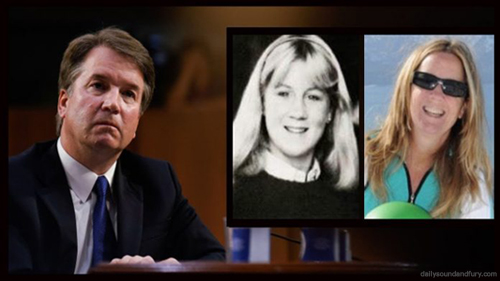
I don't believe Christine Blasey Ford was assaulted, sexually or otherwise, by Brett Kavanaugh. I don't believe that he and somewhere between one and three others — she's surprisingly hazy on the details, considering their import — stood by while he locked Ford in a room and slobbered and pawed over her like a Kennedy on mescaline. I don't believe that Kavanaugh, about whom no other allegation of anything more serious than liking basketball has ever surfaced, has ever assaulted anyone. I don't believe that uncorroborated accusations of high school tomfoolery by witnesses who are hazy on the details ought to be enough to stop Kavanaugh from renewing a library card, much less joining the Supreme Court.

I don't believe that Ford withheld such an explosive incident throughout Kavanaugh's rise through the ranks of the federal judiciary. I don't believe that she now remembers telling her husband six years ago that she was worried Kavanaugh might someday serve on the Supreme Court. I don't believe that Senator Dianne Feinstein — who knew about these allegations months ago — held on to them out of respect for Ford's privacy, which I don't believe Ford ever actually wanted.

I don't believe that the Democrats, who are now insisting that Ford be allowed to make these allegations without having to repeat them in front of the Senate panel charged with determining Kavanaugh's fitness, are doing so for any reason other than her story will fall apart under real scrutiny. I don't believe that the party of the Clintons, Al Franken, Keith Ellison, Bob Menendez and Harvey Weinstein gives a damn about Professor Ford. I don't believe that she means more to them than any of the other women whom they've used up and then thrown out like yesterday's tuna casserole. And I don't believe she'll understand that until she's standing next to Cindy Sheehan and Sandra Fluke in the "remember me?" line at the next Democrat hate rally.

I don't believe that the FBI, whose jurisdiction in this matter is pretty much non-existent, should be given an unspecified amount of time to investigate Ford's allegations, especially considering Feinstein sat on them for eight weeks, ample time for the wrong agency to conduct a thorough look at a guy whom they've already thoroughly vetted. And I don't believe that the Democrats don't know that eight weeks would be just enough to put the confirmation vote on the far side of Election Day.

I don't believe that I shouldn't care about Rep. Robert (Beto) O'Rourke (D-New York Fundraisers) and his documented episode of drunk freeway bumper cars, but I should deplore Kavanaugh and a story which is not only undocumented, but it may even be revenge on Kavanaugh's mother for an old foreclosure case. I don't believe the presumption of innocence doesn't extend to a man whose resume includes absolutely no other indications of even mildly disturbing behavior. I don't believe the most convenient accusations of all time, levied by the most convenient accuser of all time, at the most convenient moment of all time, should even slow down Kavanaugh's nomination, much less halt it.

I don't believe that allegations, which the accuser herself admits she can't recall with any degree of specificity, are anything more than a hail Mary, thrown by the people who have turned the rest of Kavanaugh's hearings into a farce. I don't believe they deserve anything more than a curt dismissal.

Sunday, September 2, 2018

Batinick “problem solving” video focuses on savings to Illinois pension systems


News From
State Representative Mark Batinick

For Immediate Release
August 20, 2018

Contact: Debbie Kraulidis
(815) 254-0000

Batinick “problem solving” video focuses on savings to Illinois pension systems


PLAINFIELD – State Representative Mark Batinick (R-Plainfield) has released his second “problem solving” video, this one concerning ways to save more than $200 million in administrative costs within the Illinois pension system.


“If you want lower property taxes, watch this short video and see how Illinois wastes $277 million per year and how we can start to solve the problem,” Batinick said.

The video highlights inefficiencies in Illinois’ various pension systems which cost taxpayers millions of dollars every year. The video is available on Rep. Batinick’s Facebook page. It can also be viewed along with an accompanying white paper with more details at www.repbatinick.com.

# # #

Mark Batinick
State Representative 97th District
815-254-0000

In order for my office to keep you up-to-date on topics concerning our district and Illinois as a whole, I would like to give you the opportunity to sign up for my E-Newsletter by just clicking the link below.

Thursday, August 30, 2018

lawsuit that claims the county failed to follow a state constitutional amendment protecting road construction funds.


Cook County seeks dismissal of lawsuit claiming violations of state constitution, state could see same challenge


FILE - Richard J. Daley Center, Daley Plaza, Cook County


Top of Form
Bottom of Form
Lawyers representing Cook County want a judge to toss a lawsuit that claims the county failed to follow a new state constitutional amendment aimed at protecting road construction funds.
If the county loses, it could put a massive hole in its budget. And the state of Illinois could be next.

A group of associations representing the construction trades sued Cook County alleging it moved $250 million meant for road, bridges and other projects to other things not related to construction. That was outlawed in 2016 when voters passed the Safe Roads “Lockbox” amendment.
The constitutional change, which was supported by a majority of voters, requires funds put into special accounts meant for roads, bridges and other construction funds to be restricted to those purposes.
Before the amendment was passed, it was commonplace for state lawmakers to authorize money be “swept” from special funds like this and then the debt would be forgiven at a later date. When construction industry groups pushed for the constitutional change ahead of the 2016 election, they said lawmakers had diverted billions in gas tax revenue designated for road work to shore up budgets.
Mike Sturino, president and CEO of the Illinois Road & Transportation Builders Association, said Cook County hasn’t been honest with its budgeting.
“When an elected official promises to raise revenue based upon transportation so that it can be reinvested to be used more as a user fee instead of a tax, the people who they represent deserve to be leveled with,” he said. “What we’ve found time and again are diversions, sweeps of money that were promised for infrastructure were being spent on unrelated uses.”
His group is looking into a number of other units of government that it suspects aren’t abiding by the constitutional provision, including the state of Illinois itself.
“The state of Illinois is one of the governmental bodies that we’re looking at to make sure they’re in compliance,” he said. “We have a number of inquiries going on throughout the state.”
Cook County State’s Attorney Kim Foxx’s office declined to comment on the pending litigation.
The hearing for the dismissal plea is set for Aug. 24.

Wednesday, August 29, 2018

You have everything to gain by making sure you vote for a Fiscally Conservative Republican

By Steve Balich

Increased Taxes cause property to loose value, business to , and less jobs. I can't think of anything positive about increased taxes. I wish we did not have to give the Government are hard earned money, but do understand you do need taxes for a limited number of things the people can't do themselves like plowing the snow on the street and maintaining infrastructure like sewers, roads, bridges, and red lights. Government unfortunately is like a BEAST eating our tax dollars as fast as they collect them.

Taxes, Rules and Regulations are always increasing if the BEAST gets its way. It is the job of each elected Official to try work to decrease the size of Government. We need to cut taxes, and regulations that are making our communities unsustainable. Business closings and people moving are a symptom of the problem. Your property tax increases and your property value decreases.

When I got on the Will County Board Democrats raised the taxes to the max and talked about implementing a Public Safety Tax. Republicans took control and cut the tax rate every year since, while building a Courthouse, Health Department, and Public Safety Building.  Point being Democrats have been in control of the State, Chicago, and Cook County for longer than I can remember. Madigan is basically the king. Look at the results of tax and spend policies. The states under Democrat control are in the worst fiscal Condition.

The answer is to vote Republican. You have everything to gain by making sure you vote for a Fiscally Conservative Republican


Tuesday, August 14, 2018

No One Mentions That The Russian Trail Leads To Democratic Lobbyists


No One Mentions That The Russian Trail Leads To Democratic Lobbyists

Retired Army Lt. General Michael Flynn arrives for the Presidential Inauguration of Donald Trump at the US Capitol in Washington, DC, January 20, 2017. Flynn is appointed National Security Advisor to Trump. / AFP / POOL / SAUL LOEB (Photo credit should read SAUL LOEB/AFP/Getty Images)
K Street lobbyists are the symbol of Washington influence-peddling as they push government for favors, subsidies, exemptions, and other special treatment for their clients. Their customers include, in addition to domestic clients, foreign governments, oligarchs, fugitive speculators, and a rogue’s gallery of questionable figures. Washington lobbyists trade on their access to power. Many are former administration officials or members of Congress. If Trump fulfills his promise to “drain the swamp,” these influence peddlers would have nothing to sell. They are under attack.

The media has focused not on K Street but on the Russian ties of President Donald Trump’s associates. They list the reprehensible Kremlin-associated figures for whom members of his inner circle worked, the most notorious being Viktor Yanukovich, the deposed president of Ukraine, and fugitive oligarch, Dymtro Firtash. But both of these “repulsive” figures were also advised by Democratic top dogs, who likely earned large multiples of what the “small fry” Trump associates took home.
In pushing its Manchurian-candidate-Trump narrative, the media fail to mention the much deeper ties of Democratic lobbyists to Russia. Don’t worry, the media seems to say: Even though they are representing Russia, the lobbyists are good upstanding citizens, not like the Trump people. They can be trusted with such delicate matters.

The media targeted former Trump campaign manager, Paul Manafort, for consulting for deposed Ukrainian president’s (Yanukovich’s) Party of the Regions. He also worked for billionaire oligarch, Firtash, who stands accused of skimming billions in the Ukraine gas trade in league with Russian oligarchs. The media also singled out Trump’s former national security advisor, General Michael Flynn, for attending a dinner with Putin and appearing on Russia’s foreign propaganda network RT. Trump’s own Russian ties were the subject of intense media coverage of an unverified opposition-research report purportedly prepared by an ex-British spy, who remains in hiding. It seems no enterprising reporter has tried to find him.
The media’s focus on Trump’s Russian connections ignores the much more extensive and lucrative business relationships of top Democrats with Kremlin-associated oligarchs and companies. Thanks to the Panama Papers, we know that the Podesta Group (founded by John Podesta’s brother, Tony) lobbied for Russia’s largest bank, Sberbank. “Sberbank is the Kremlin, they don’t do anything major without Putin’s go-ahead, and they don’t tell him ‘no’ either,” explained a retired senior U.S. intelligence official. According to a Reuters report, Tony Podesta was “among the high-profile lobbyists registered to represent organizations backing Ukrainian President Viktor Yanukovich.” Among these was the European Center, which paid Podesta $900,000 for his lobbying.
That’s not all: The busy Podesta Group also represented Uranium One, a uranium company acquired by the Russian government which received approval from Hillary Clinton’s State Department to mine for uranium in the U.S. and gave Russia twenty percent control of US uranium. The New York Times reported Uranium One’s chairman, Frank Guistra, made significant donations to the Clinton Foundation, and Bill Clinton was paid $500,000 for one speech from a Russian investment bank that has “links to the Kremlin that was promoting Uranium One stock.”  Notably, Frank Giustra, the Clinton Foundation’s largest and most controversial donor, does not appear anywhere in Clinton’s “non-private” emails. It is possible that the emails of such key donors were automatically scrubbed to protect the Clinton Foundation.
Let’s not leave out fugitive Ukrainian oligarch, Dymtro Firtash. He is represented by Democratic heavyweight lawyer, Lanny Davis, who accused Trump of “inviting Putin to commit espionage” (Trump’s quip: If Putin has Hillary’s emails, release them) but denies all wrongdoing by Hillary.
That’s still not all: Rep. John Conyers (D., Mich.) read Kremlin propaganda into the Congressional Record, referring to Ukrainian militia as “repulsive Neo Nazis” in denying Ukrainian forces ManPad weapons. Conyers floor speech was surely a notable success of some Kremlin lobbyist.
Lobbying for Russia is a bi-partisan activity. Gazprombank GPB, a subsidiary of Russia’s third largest bank, Gazprombank, is represented by former Sen. John Breaux, (D., La.), and former Senate Majority Leader Trent Lott (R., Miss.), as main lobbyists on “banking laws and regulations, including applicable sanctions.” The Breaux-Lott client is currently in the Treasury Department list of Russian firms prohibited from debt financing with U.S. banks.
In his February 16 press conference, President Trump declared in response to the intensifying media drumbeat on his Russian connections: “I haven’t done anything for Russia.” K-Street lobbyists, on the other hand, have done a lot to help Russia. They greased the skids for a strategic deal (that required the Secretary of State’s approval) that multiplied the Kremlin’s command of world uranium supplies. They likely prevented the shipment of strategic weapons needed by Ukraine to repulse well-armed pro-Russian forces. A fugitive billionaire who robbed the Ukrainian people of billions is represented by one of the establishment’s most connected lawyers.
Gazprombank GPB hired Breux and Lott to gain repeal of sanctions. That’s perfectly fine in Washington; they are playing according established “swamp rules” in their tailored suits and fine D.C. restaurants. General Flynn lost his job when the subject of sanctions was mentioned by the Russian ambassador in their telephone conversation, but that’s the way the media and Washington play.
No wonder that Trump’s’ “drain the swamp” and anti-media messages resonate so well with mainstream America.

Saturday, August 11, 2018

Your bank and the government


Your bank and the government 

By Bob Livingston

The world's most profitable industry has no product of any kind and pays no taxes of any kind whatsoever. This is the banking industry.
Banking with your local friendly banker has become "institutionalized" in our thinking. Few people are aware that a bank account is a profile of their life.
The IRS Special Agent's Manual states that the testimony of the taxpayer himself via the form 1040 tax filing and especially his bank account are the best sources of evidence (against the "taxpayer" of course).
In other words, your testimony and your bank account mean self-incrimination. This is worse than the old Star Chamber and a direct violation of the 5th Amendment.
Your bank isn't your friend. Even if the people at the bank want to be loyal to you, they're required by law to report what you're doing to government agencies — and they're not even allowed to tell you when they do it.


The Financial Crimes Enforcement Network (FinCEN) was established in 1990 by order of the Secretary of the Treasury. It seemed innocuous enough at first. But as new responsibilities and powers were given to the bureau, it became a very big deal.
Banks have long been required to file currency transaction reports when individuals deal in cash. Every cash transaction over $10,000 must be reported.
Governments want to be able to track money. Since cash is harder to track, government agencies want to be notified so they can look into cases in which people deposit or withdraw large sums of cash. And government men especially want to know about it if you try and preserve your privacy by breaking up your transactions. It's called the crime of "structuring," and if you do it you'll automatically be branded a money launderer and likely charged with a crime. But with the passage of the USA (Un)Patriot Act in 2001, the government has greatly stepped up its snooping into your financial affairs.
The (Un)Patriot Act required FinCEN to establish a secure network that allows the agency to keep tabs on what anyone is doing at any of the 27,000 financial institutions in the U.S. This sinister system allows government snoops to have real-time access to your information and to what you're doing. If you're on their radar screen, they can know everything you're doing. Your information is identified, centralized and then evaluated by various agencies in law enforcement.
Financial institutions are scared to death of being fined or even shut down by the federal government for being out of compliance with provisions of the (Un)PatriotAct. So, just to be safe, they are busily sending in information to FinCEN about their customers and filing reports on any customer activity the Feds may potentially regard as "unusual."
FinCEN reports show that banks are turning in their customers for investigation by FinCEN and the IRS for such "offenses" as making heavy use of an automated teller machine, for receiving or sending international wire transfers or because the bank does not know the source of deposited money.
You think your bank account is secure — you are told, after all, it is guaranteed by the Federal Deposit Insurance Corporation — but the IRS can wipe it out with the touch of a button and doesn't even have to inform you it's doing so, and the bank is not required to inform you.
I have an acquaintance whose personal and business accounts were wiped clean by the IRS after it rejected a technical aspect of his business tax filing even though he was working with the IRS in good faith to resolve the dispute. But what's worse, the IRS wiped clean his daughter's account as well, even though she did not live with him and was away at college. The business owner didn't know his own account was empty until his daughter called to complain that her money had been stolen.
It took him months to get this straightened out and he had to operate the whole time without access to any of the money he had on deposit — even his savings. Try buying food and necessities or paying your bills when that happens.
Nor is a safe deposit box secure, as many have found. There is all manner of precedent for seizing, blocking and breaking and entering safe deposit boxes.
Cash money in a safety deposit box or anywhere is presumed to be illegal. This is the excuse to seize it, saying it is your burden to prove that you paid taxes on it, that it is not illegal proceeds from drugs or that it is not laundered money. Guilty until proven innocent is contrary to American jurisprudence and Bill of Rights but is the case in any dealing with the IRS and most other government agencies.
On the fine print of your safe deposit box contract you will likely find something like this: "Lessee acknowledges that the safe deposit box is not intended to store without limitations, such things as domestic or foreign currency whether in paper, coin, or other form."
Federal rules say a bank can drill a box without permission if there's a court order, search warrant, delinquent rental fee, request from estate administrators or if the bank is closing a branch. In other words, if the bank reports your banking activities as suspicious for whatever reason, government enforcers can rifle the contents of your safe deposit box without you even being informed.
Asset forfeiture by government at all levels means that your assets are vulnerable without your ever being charged with a crime. Asset forfeiture is loved by law enforcement — including chief drug warrior, the feckless fossil of an Attorney General Jeff Sessions — for the so-called "War on Drugs."
But even if government doesn't steal your valuables from you under specious circumstances, someone else may. Bank of America seems to be experiencing a rash of safe deposit box thefts of late.
Recently a California woman who had retired from BoA learned that the safe deposit box that she had maintained for 16 years had simply vanished.
"I was in shock. I was just, like, what happened to my box," Susan Nomi told CBS Sacramento. "They don't have an answer. They don't have an answer. They say, 'Thanks for letting us know.'"
Another BoA customer, Wendy Woo, said her belongings were taken out of her safe deposit box and shipped to her by the bank, as ZeroHedge reports:
"Everything was dumped in a plastic bag," said Woo. In the process, a ring went missing and a necklace was damaged in the process (sic). "Safe deposit box... that's what it's for, safe," she said, only not when the safe belongs to Bank of America. A second family complained that it too had gotten th…
Nor are these the only ways banks steal from you with government sanction. Fractional reserve banking is a massive Ponzi scheme that makes what Charles Ponzi did look like penny ante poker, as I explained in "How banks and the government rob you blind."
Banks hold only a fraction of your money in an account, and they do not have reserves on hand to cover all the debt owed them by their customers and all the savings customers have deposited. In other words, banks are bankrupt, except for their ability to "create" money.
We recommend you avoid safe deposit boxes for anything of value. A fireproof safe secreted and secured on your property is a far better option for things of value. You should keep no more money in the bank than is necessary for paying one or two months of bills. You should keep some cash on hand — in case of a bank run, power outage or significant disruption in the financial system — and keep the rest of your holdings in gold and silver in your possession.
For more information on preserving your assets in these uncertain times we urge you to consider our "Ultimate 'End of the Dollar' Defense Manual," available here.

Thursday, August 2, 2018

In Illinois, when will hitting 'record' not land you in prison?


In Illinois, when will hitting 'record' not land you in prison?

·         

·          FILE - Recording conversation on phone
Top of Form
Bottom of Form
XanderSt | Shutterstock.com
Top of Form
Bottom of Form
A 13-year-old boy’s felony charge for recording his middle school principal begs the question: When is it OK to record someone without breaking Illinois state law?
Paul Boron recorded his principal and another school official when they talked to him about missing detention. When the school leaders learned Boron was recording, they reported it. The Kankakee County State's Attorney charged Boron with a Class 4 felony in April. The same as aggravated DUI and first-time weapon offenses.
What Boron did is legal in most other states. Illinois is what’s known as a two-party consent state, meaning that recording someone without permission in even a semi-private area is a Class 4 felony. The key term in the law is a “reasonable expectation of privacy.” Recording a phone call, for instance, would likely be a felony.
“The principal of two-party consent is something that Illinois has that provides people with a greater degree of privacy than in many other states,” ACLU Illinois staff attorney Ben Ruddell.
In Boron’s case, Ruddell said everyone involved went too far.
“It was entirely inappropriate for this situation to be dealt with in this manner,” he said. “To criminalize this young man and make a felon out of him is something we can unequivocally say is the wrong thing to do.”
Opponents of Illinois’ two-party consent law says it’s too broad, allowing for abuses of authority in the same manner as the Manteno school officials did against Boron. Many cases of this law being charged is when a private citizen records public officials, even law enforcement.
·         F

Friday, July 27, 2018

The Moon Landing and Our Lost Half-Century


The Moon Landing and Our Lost Half-Century

The Moon Landing and Our Lost Half-Century
Forty-nine years ago, today, we had every reason to believe that Neil Armstrong’s “small step for [a] man,” was in fact the first part of a “giant leap for mankind.”
At the time, it was reasonable to expect that our space program would continue to move at the pace of the Apollo program. It was therefore reasonable to think that by 2018 we would have four to five colonies on the Moon, space-based outposts in various lunar and cislunar orbits, mining operations on several asteroids, and a preliminary habitat on Mars.
In fact, when Arthur C. Clarke wrote 2001: A Space Odyssey in 1968, it made sense to mark 2001 as the timeframe in which humans would develop the technology and shape the reality that he described.
However, we have clearly fallen short of Armstrong’s and Clarke’s visions.
Instead of building a robust space program, we built a robust space bureaucracy. After nearly 50 years wandering in a mostly Earth-bound wilderness of red tape – and spending roughly $555 billion on risk averse, underwhelming, mostly unmanned space observation projects – we have not truly taken Armstrong’s giant leap.
I did an episode of my Facebook series "What If? History that Could’ve Been" about how different America – and humanity – would be had the U.S. continued to build on the John F. Kennedy-era space program. President Nixon’s decision to slow down and moderate the Kennedy space program amounted to one of the biggest hits to scientific advancement in our country’s history. It set us down the path of high costs and large bureaucracy that now dominates NASA.
What If? History with Newt
However, we are currently at a turning point that could course-correct this misstep.
President Trump represents a fundamental change in thinking about space, just as he is a fundamental change agent in so many other areas.
In signing the re-establishment of the National Space Council after 25 years he said, “America will think big once again. Important words: Think big. We haven’t been thinking so big for a long time, but we’re thinking big again as a country. We will inspire millions of children to carry on this proud tradition of American space leadership — and they’re excited — and to never stop wondering, hoping, and dreaming about what lies beyond the stars.”
Vice President Mike Pence may be the perfect implementer of the “think big” space approach. Pence has always been fascinated by space. Before he won a congressional seat, he drove to Florida with his family to watch rockets being launched. Chairing the Space Council may be the assignment that makes him happiest.
Furthermore, in some ways, the Trump-Pence approach is even broader than the JFK approach. Kennedy was using space to influence a cold war on Earth. Trump and Pence want Americans to go into space permanently.
The interim post-Apollo, pre-Trump NASA system has focused on sending very-well trained astronauts on expensive, narrowly focused missions (look at their planning for a Mars trip nearly two decades from now).
Trump and Pence want ordinary Americans with modest training going into space as pioneers and colonizers. Their vision inherently requires dramatic drops in cost and increases in capability. It is the same model we followed while exploring the North American continent. First came the “professionals” and then came the settlers as soon as economic viability was established. Fifty years after the first human extraterrestrial landings, we are about to enter the second phase of American space exploration.
The amazing thing about this moment in space policy is that an entrepreneurial president can now turn to entrepreneurial leaders for less expensive, more accessible space assets.
Jeff Bezos, Elon Musk, Paul Allen, Richard Branson, and Eren and Fatih Ozmen (the owners of Sierra Nevada Corporation) are leaders working to make access to space cheaper and more reliable for normal people.
The new approaches of Bezos’s Blue Origin and Musk’s SpaceX will lower costs by at least 40 percent (and the next generation of reusables with new materials technology may take that reduction even further). Equally important, these entrepreneurs are the forerunners of new systems that will have daily launches – instead of monthly launches.
When combined with 3D printing, robotics, artificial intelligence, and microminiaturization, the breakthroughs in launch cost and frequency will lead Americans to the Moon, Mars, and mining asteroids.
Under the Trump-Pence spacefaring vision, we could quickly expand the experience of few astronauts, to extraterrestrial habitats for dozens, hundreds, and eventually thousands of Americans.
After the extraordinary success of the Kennedy challenge, we unfortunately turned our attention back to Earth.
If the Trump-Pence challenge prevails, Americans will be living beyond Earth and looking toward the stars for the rest of our existence.
It is this tremendous effort to democratize space and turn access to space into an opportunity for everyone that will help us to finally achieve the “giant leap” that Armstrong knew would take us into a much brighter, more exciting future.

Urgent care centers over prescribing antibiotics for profit, not health


Urgent care centers over prescribing antibiotics for profit, not health

By Bob Livingston
People are often taken aback when they see me write that modern medicine is a killing machine for profit.
Believe me, I take no pleasure in stating it. It places me on the wrong side of conventional wisdom and subjects me to all manner of abuse. That’s because by the time people reach adulthood, the system has sealed their thought processes so that nothing is questioned. What the doctor says is gospel. The imperative to inquire and question is gone.

We are literally a prescription drug culture, and we accept the doctor’s advice on drugs without question, not suspecting that the drug the doctor prescribes is done so based on a monetary interest as much or more than a medical one. Hospitals and medical research centers have become virtual temples to human experimentation in the “quest for knowledge.”
The modern mind has been conditioned to equate medicine with health. If you get sick, so conventional wisdom goes, then you must need a drug or drugs to “cure” the sick… otherwise you will remain sick.
So the doctors prescribe a drug or drugs to address the symptoms. They practice symptomology. They doctor the symptoms, not the underlying cause of the disease. Sometimes these drugs make people feel better for a time. Sometimes they make the person feel better until the body manages to cure itself.
This is especially true when it comes to treating common and everyday illnesses like colds and flus and other upper respiratory infections. But the piper must eventually be paid.  And we’re paying it in the form of the rise of antibiotic-resistant drugs.
The Centers for Disease Control and Prevention tells us that each year at least 2 million people become infected and at least 23,000 die from antibiotic-resistant infectious agents.  A 2015 report from Public Health England found that “significant antibiotic-resistant infection” rose significantly from 2010 to 2014.
Antibiotic-resistant “superbugs” are growing ever more prevalent and ever more deadly. This increase comes as a direct result of the growing and widespread use of general antibiotics across the human spectrum.
Antibiotics are pumped into the chickens we eat and that produce our eggs. Antibiotics are pumped into the cattle that we eat and that produce our milk. Antibiotics are pumped into the pork we eat. Antibiotics are pumped into the turkeys we eat.
On top of that, doctors are prescribing antibiotics pre-surgery and post-surgery, whether or not infections are present. And medical practitioners are not only prescribing antibiotics for common bacterial and fungal infections, but also for viral infections on which antibiotics have no effect. And this is often done, the doctors admit, in order to placate parents conditioned — as mentioned above — to equate medicine with health and who do not want to hear that the earache little Johnny is suffering from will heal on its own if Johnny’s immune system is made strong.
The worst offenders for over-prescribing antibiotics are urgent care centers, according to new analysis published in JAMA International Medicine.
Based on insurance claims from patients with employee-sponsored coverage, researchers estimated that about 46 percent of patients who visited urgent care centers in 2014 for conditions that cannot be treated with antibiotics—such as a common cold that’s caused by a virus—left with useless antibiotic prescriptions that target bacterial infections. That rate of inappropriate antibiotic use is almost double the rate the researchers saw in emergency departments (25 percent) and almost triple the rate seen in traditional medical offices (17 percent).
The authors of the analysis—a team of researchers from the Centers for Disease Control and Prevention, the University of Utah, and the Pew Charitable Trusts—concluded that interventions for urgent care centers are “urgently needed.”
The data is concerning, the team notes, because such misuse of antibiotics can fuel the development and spread of drug-resistant bacteria, which can go on to become resistant to multiple types of antibiotic drugs and cause intractable, sometimes deadly, infections.
It’s also concerning because of the increasing number of the urgent care centers popping up across the country – there are more than 10,000 in existence and they’re doing a $15 billion business.
Researchers for JAMA Internal Medicine worry that getting doctors at these clinics to dial back their use of antibiotics will be difficult because judicious use of antibiotics doesn’t fit their business model. There’s quite a bit of a “pot-calling-the-kettle-black” going on here, as doling out pills is also the business model of the doctors doing the warning.
ArsTechnica notes that urgent care clinics are designed for convenience and to provide same-day service by funneling as many patients as possible through the doors at low out-of-pocket cost for ailments that don’t warrant an emergency room visit and for patients who don’t want to wait to see their primary doctor or don’t have one.
Lacking a relationship with the patients, who are seen in assembly line fashion, doctors lack the will or motive to try and dissuade the patients from getting the so-called “quick fix” antibiotic injection or bottle of pills, even for ailments the doctors know that antibiotics won’t affect. But they do have the financial incentive to keep patients happy and willing to return for another shot or bottle of pills next time they get sick.
Another study, published in the Journal of Antimicrobial Chemotherapy, found that “[B]oth the number of physicians per capita and the number of clinics are significant drivers of antibiotic prescription rate… The increase in the number of antibiotic prescriptions written in wealthy areas appears to be driven primarily by increased competition among doctors’ offices, retail medical clinics and other health care providers as they seek to keep patients satisfied with medical care and customer service.”
This is especially true in wealthier areas where patients are able to shop around for care that offers them what they want – a quick fix — rather than what may be in their long-term best interests.
But beyond the danger of “superbugs,” taking too many antibiotics leads to a host of health problems. Antibiotics don’t discern which bacteria to kill and they wipe out the body’s good bacteria with the same abandon as the bad. Good bacteria in the gut play a positive role in promoting a healthy immune system. Antibiotics wipe them out.
If we are to survive modern medicine we must take charge of our own health. Question the doctor on all treatment suggestions and prescriptions. Check the medication’s side effects via a Physician’s Desk Reference or using an online source like Drugs.com. Make sure your health is the consideration rather than the physician’s profits.
You also need to make sure you’re as healthy as possible and have a strong immune system. Disease comes from within. When the body is overly fatigued with excess stress, toxins and malnutrition, there is a breakdown of immunity. So a body must be made healthy with proper hydration and proper nutrition(which means whole foods, mostly raw, and very little meat). It must have a healthy pH and it must have a proper level of essential nutrients, not antibiotics which are becoming less effective at killing the “bad” bacteria but continues to kill the “good” bacteria the body needs to remain healthy.