|
Showing posts with label #taxes. Show all posts
Sunday, November 11, 2018
They're bidding for what?!!!
Saturday, November 10, 2018
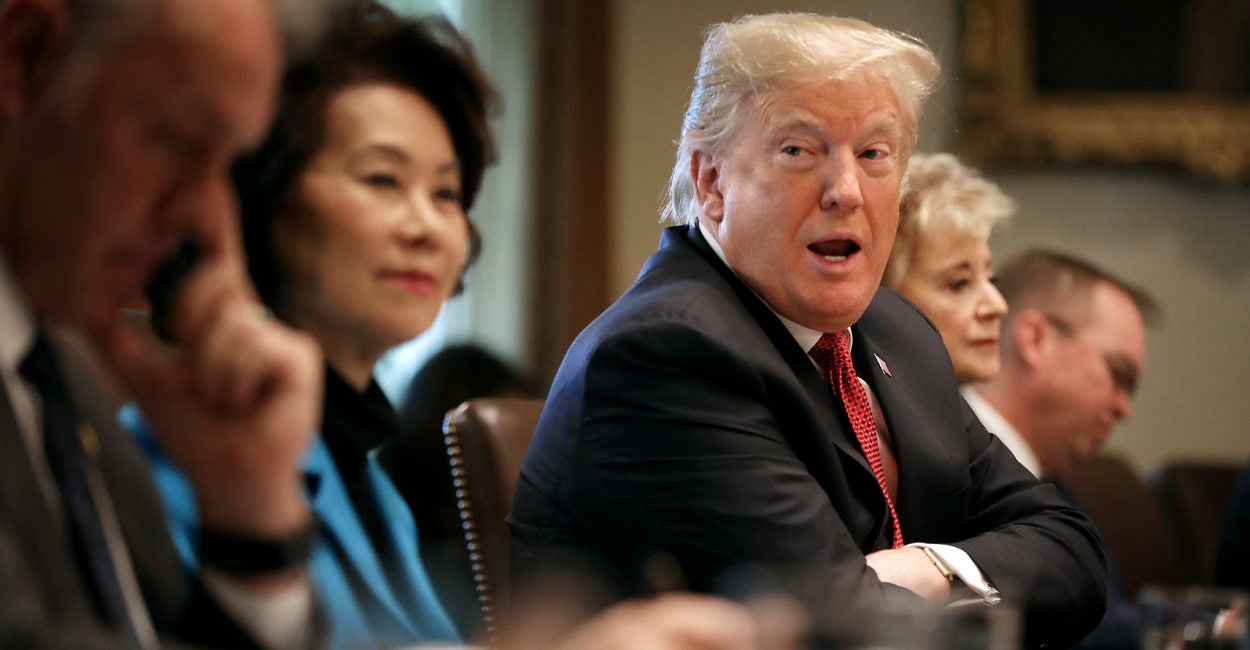
Trump’s Plan to Cut Budget by 5% Meets With Skepticism

From the Daily Signal
With the federal budget deficit reaching $779 billion, President Donald Trump is asking Cabinet members to cut spending in their departments by 5 percent next fiscal year.
Because such trimming is hardly slashing the total budget, however, some experts question whether that even will make a difference in fiscal 2020, which will begin Oct. 1, 2019.
The national debt is more than $21 trillion.
“We’re going to ask every Cabinet secretary to cut 5 percent for next year,” Trump said Wednesday during a Cabinet meeting.
The president, asked about increases in defense spending, said: “The military was falling apart, it was depleted, it was in very bad shape.”
Congress approved an increase in the military budget to $716 billion for fiscal 2019, but there will be a cut, Trump said, “probably” to $700 billion, for fiscal 2020.
Given the $779 billion budget deficit, and a 13 percent increase in discretionary spending from 2017 to 2018, each department should be able to cut 5 percent, said Justin Bogie, senior policy analyst in fiscal affairs for The Heritage Foundation.
Federal spending is also set to increase by more than 3 percent from 2018 to 2019. Congress and federal agencies should adhere to the 2011 Budget Control Act, which limits the growth in spending, Bogie said.
“Congress should stick to the current discretionary budget caps and, moving forward, should look to implement a cap on all spending,” Bogie told The Daily Signal. “We support defense spending to the level needed. But if you increase it, you should find a way to pay for it through cuts elsewhere.”
The president acknowledged that some fiscal hawks likely won’t believe a 5 percent cut is enough.
“Some will say I can do much more than 5 [percent],” Trump said during the Cabinet meeting, but added: “It will get rid of the fat, get rid of the waste. It’ll have a huge impact.”
Such a cut is achievable, since government spending increased by 16 percent in the previous two years, said Maya MacGuineas, president of the nonprofit Committee for a Responsible Federal Budget.
“We should be able to scale back one-third of that, easily,” MacGuineas said in a prepared statement. “A 5 percent cut will actually cost money, though, since current law brings back budget caps next year that equal a 10 percent cut. So going with 5 percent over 10 percent means a $63 billion deficit increase just for a single year.”
She added:
Something will have to give if we stay on our current track. With trillion-dollar deficits returning in as soon as a year—indefinitely—5 percent budget cuts to a small portion of the budget will pale in comparison to what will be needed in 15 years.Thoughtful reforms phased in now over time will be much better for the American people and economic growth.
Presidential budget proposals rarely are enacted by Congress.
Some Cabinet members previously ran large organizations and will have some expertise in managing waste, said Tom Schatz, president of the nonprofit Citizens Against Government Waste.
“This is better than nothing, but we’d like to see more,” Schatz told The Daily Signal. “It’s achievable. We’d rather see a 10 percent cut.”
“If this was the Trump Organization,” Schatz said of the president, “he could say he wants a 10 percent cut and employees would come back with 15 percent. But given how government works, 5 percent is a good start.”
Tuesday, October 30, 2018
Growing number of $100,000-plus public pensions in Illinois cost taxpayers

The Illinois State Capitol in Springfield, Illinois.
John Spataro | Illinois News Network
Two recent studies of public sector pay and retirement benefits show tens of thousands of retired Illinois public employees making six-figures or more in all levels of government, dwarfing figures from states with more people.
Two organizations that reviewed and released the information hope it encourages taxpayers to seek change.
Illinois has more than $130 billion in unfunded pension debt for its five state-run pension systems. Adding in other post employment benefits, that number climbs to more than $200 billion. Municipal governments in Illinois also are struggling with unfunded pension liability. Some report using most, if not all, of their share of property taxes to pay pension costs.
Taxpayers United of America said Illinois’ public sector pension plans are too expensive. To highlight the problem, its annual pension report of all public employees in Illinois shows nearly 19,500 government retirees getting a pension of $100,000 or more. That’s 2,500 more retirees than last year.
The group's founder, Jim Tobin, said that’s just the tip of the iceberg.
“The pensions are just out of line,” he said. “We’ve got one guy here who’s getting an annual pension of almost $600,000 a year and he’ll get $22 million if he lives to be 85. It’s ridiculous.”
OpenTheBooks.com founder Adam Andrzejewski said Illinois has more educators in the so-called $100,000 Club than more populous Texas, which has 7,300 educators making that much or more.
“Just on salaries, Illinois has nearly 20,000, so it’s three times worse, yet Texas has twice the population,” Andrzejewski said.
Andrzejewski’s research shows overall, 23,000 retirees got $100,000 or more in annual pension payments. Adding in the 71,000 employees at every level of government making at least that much in pay, and the number is 94,000 current public employees or pensioners making $100,000 or more a year. That costs taxpayers $12 billion a year.
There were also private associations Andrzejewski’s research highlights where it’s employees are getting big payouts.
“Two of the highest earners within the municipal pension system work for private associations – not government,” the report said, showing two park district association officials making more than $320,000 a year. “These private nonprofits muscled their way into the government system, and their huge salaries will guarantee lavish taxpayer-funded pensions.”
Then there are double dippers, including a former governor.
“Former Illinois Governor Jim Edgar double dipped the Illinois General Assembly pension ($166,000 per year), the State University Retirement System pension ($83,000 per year), and was hired back ‘part time’ by the University of Illinois for another $62,769,” Andrzejewski’s report said. “In total, Edgar pulled down more than $311,000 last year – in addition to the $2.4 million in compensation from the University of Illinois (2000-2013) and another $2 million in pension payments already paid-out from his 20-year career as legislator, secretary of state and governor.”
The Taxpayers United of America report found there are two pensioners making $500,000 or more a year. Nine retirees are getting in excess of $400,000 a year in pensions, 42 make $300,000 or more a year. From there, the numbers climb. More than 440 government retirees make $200,000 or more a year. More than 19,480 government retirees make $100,000 a year while the bulk, 107,092, make more than $50,000 in annual pensions.
The average total public sector pension payout for a lifetime, according to Taxpayers United of America, is $1.45 million in Illinois while the average retirement age almost 61 years old.
“We have to work into our 60s and 70s so these people can retire in their 50s and 60s on these ridiculous exorbitant pensions which is nothing short of legalized theft,” Tobin said.
Even more stark is what Taxpayers United of America reports employee withholdings deposited into the various funds, or $1.9 billion, compared with the $8.7 billion taxpayers pay into the funds.
“Nowhere is that available in the private sector,” Tobin said. “It’s just something that doesn’t happen, but it happens here in Illinois every time people get into these government pensions wherever they are in the state of Illinois.”
Tobin said all government new hires must be put in self-managed plans and the state constitution should be changed to allow diminishment of benefits.
Andrzejewski said “it’s time to slap a pay cap on the highly compensated public employees at every level of Illinois government.”
“People need to raise their voice, they need to give public comment, they need to start holding their elected officials accountable for tax and spend decisions,” Andrzejewski said.
The exorbitant pay and benefits is unsustainable, he said, and it takes resources away from other government services.
Wednesday, October 24, 2018
Who Are the Real Partisans?

Who Are the Real Partisans?
Written by David Limbaugh
Someone please tell me what bizarro world Democratic activists inhabit — those who are grumbling that Republicans are unscrupulous partisan warriors imposing their agenda by government coercion and trampling the innocent, passive left in the process.
This is frighteningly delusional and shockingly divorced from reality.
Without question, Democrats and their never-Trump supporters on the right would have us believe that Donald Trump is the very creator of partisan politics, someone who has gobsmacked the unsuspecting collegial political left into abject impotence.
By their telling, Barack Obama was an exemplar of bipartisanship, a man who never met a Republican he wasn’t willing to work with. Obama really meant it when he said he was ushering in a new era of cultural harmony in America centered on our “common humanity” — a favorite phrase of the left that conveys no meaning and serves no purpose other than to cloak a militant call to political activism with an elegant lilt.
The left knows that Trump didn’t introduce partisan stridency to American politics. It’s been with us since the beginning of the republic. In fact, Obama was one of the most partisan presidents of the modern era. He demanded the wholesale adoption of his agenda — not compromise and conciliation. He is the one who rammed through Obamacare against the will of the people, the one who responded to pleas for compromise with “I won,” “I’m the president” and “Elections have consequences.”
Obama said:
- “If they bring a knife to the fight, we bring a gun.”
- “I don’t want the folks who created the mess to do a lot of talking. I want them just to get out of the way so we can clean up the mess.”
- “I need you to go out and talk to your friends and talk to your neighbors. I want you to talk to them whether they’re independent or whether they are Republican, and I want you to argue with them and get in their face.”
- “We talk to these folks because they potentially have the best answers, so I know whose a– to kick.”
- “If Latinos sit out the election instead of saying, ‘We’re going to punish our enemies, and we’re going to reward our friends who stand with us on issues that are important to us’ — if they don’t see that kind of upsurge in voting in this election — then I think it’s going to be harder. And that’s why I think it’s so important that people focus on voting on Nov. 2.”
And Trump is the authoritarian? Really? How about Obama’s endless use of lawless orders, such as on immigration, to implement an agenda that he couldn’t get passed through the duly elected legislative branch? How about the targeting of conservative groups by his IRS and overreaching by his Environmental Protection Agency? Trump’s tough rhetoric somehow constitutes an abuse of authority when Obama’s actual usurpations didn’t?
And consider what Hillary Clinton has to say about working with Republicans. This week on CNN, she said:
“You cannot be civil with a political party that wants to destroy what you stand for, what you care about. That’s why I believe if we are fortunate enough to win back the House and/or the Senate, that’s when civility can start again.”
Which major political party is bullying members of the other one out of restaurants? Which is refusing to accept the U.S. Supreme Court confirmation process and disrupting congressional proceedings and shrieking outside the U.S. Supreme Court like maniacal demons waging full-scale spiritual warfare?
Which party demands partisan lockstep among members of a gender or race and ridicules women and blacks (Kanye West) as sellout know-nothing traitors if they stray from the party’s plantation? Do you ever see people pressured to leave their media jobs for supporting a liberal cause? Well, a CBS reporter in California resigned after expressing favorable comments about Brett Kavanaugh. Do you ever see liberal students punished by conservative university professors (what few there are) for expressing their political views? Name one Hollywood liberal afraid to express a political opinion because he or she could lose work. Name one conservative initiative on any college campus to impose a speech code on students.
Conservatives have awakened from their slumber and their naive complacency, realizing that the cultural and political left, the liberal media and the Democratic Party apparatus are relentless warriors engaged in an ongoing struggle to impose their agenda by any means possible, irrespective of the Constitution and rule of law.
That’s a primary reason President Trump has become so popular among conservatives. He is showing Republicans that he understands we are in a fight over the future of this nation and is providing a template for fighting back.
When a recent caller to my brother’s radio show complained that Democrats and liberals are fighting dirty and that we can’t save this nation unless we begin to get right down in the mud with them, Rush gently corrected him, saying, “We don’t need to fight dirty to win; we just need to fight as fiercely and intensely as they do.”
Sunday, October 7, 2018
The everything bubble: When will it finally crash?
By Brandon Smith
Much like the laws of physics, there are certain laws of economics that remain constant no matter how much manipulation exists in the markets. Expansion inevitably leads to contraction, and that which goes up must eventually come down. Central banks understand this reality very well; they have spent over a century trying to exploit those laws to their own advantage.
A common misconception among people new to alternative economics is the idea that central banks only seek to keep the economy afloat, or keep it expanding forever. In reality, these institutions and the money elites behind them artificially inflate financial bubbles only to deliberately implode them at opportunistic moments.
As I have outlined in numerous articles, every economic bubble and subsequent crash since 1914 can be linked to the policy actions of central bankers. Sometimes they even admit to culpability (to a point), as Ben Bernanke did on the Great Depression and as Alan Greenspan did on the 2008 credit crisis. You can read more about this in my article 'The Federal Reserve Is A Saboteur — And The "Experts" Are Oblivious.'
Generally, central bankers and international bankers mislead the public into believing that the crashes they are responsible for were caused "by mistake." They rarely if ever mention the fact that they often use these crises as a means to consolidate control over assets, resources and governments while the masses are distracted by their own survival. Centralization is the name of the game. It is certainly no mistake that after every economic implosion the wealth gap between the top 0.01 percent and the rest of humanity widens exponentially.
Yet another crash is being weaponized by the banks, and this time I believe the motivations behind it are rather different. Or at least the goals are supercharged.
The next phase of the financial elite's plans for centralization involve a complete restructuring of the global monetary climate, something Christine Lagarde of the IMF has often referred to as the great "economic reset." The term "economic reset" is more likely code for "economic collapse," one epic enough to facilitate a completely new monetary framework with a new global reserve currency. A historically unprecedented economic reset would require a historically unprecedented financial bubble, which is exactly what we have today.
The 'Everything Bubble' as many alternative analysts are calling it is built upon multiple crumbling pillars. Here they are in no particular order:
Central bank stimulus
Bailouts and QE measures on the part of central banks have been used as a stopgap since the 2008 crash to prevent market reversal whenever they appear. Most of all, central banks have been particularly obsessed with keeping stocks in a perpetual bull market, which Ben Bernanke and Alan Greenspan admitted was part of maintaining a certain positive "psychology" within the public. In other words, the purpose of stimulus measures was to give the masses a false sense of security, not heal the real economy.
The other primary initiative behind stimulus was to prop up debt poisoned governments and corporations around the world. However, the intention was not necessarily to help these institutions climb out of the red. No, instead, the goal was to keep them semi-solvent long enough for them to take on even more debt, to the point that when they do collapse the aftermath will be so devastating that recovery would be impossible.
The timing of central bank tapering of QE should be treated as an alarm on the crash of the everything bubble. With the Federal Reserve cutting off QE measures, the Bank of Japan using "stealth tapering," and the European Central Bank warning of high inflation and the need for tapering, it is clear that the era of easy money is almost over. When the easy money is gone, the crash is near.
Stock buybacks
Using steady loans from the Federal Reserve as well as Trump's tax cut, stock markets have been inflated beyond all reason by corporations implementing the equities manipulation scheme of stock buybacks. By artificially reducing the number of stock shares on the market, companies can increase the "value" of the existing shares and fuel a bull market rally. This rally has nothing to do with actual wealth creation, of course. It is a game of phantom wealth and inflated numbers.
Stocks in particular will require ever more debt on the part of corporations along with never-ending near zero interest rates in order to keep the farce going. The central banker, though, have other plans.
Near zero interest rates
Low interest rates should be considered a part of the stimulus model, but I'm setting them separately because they represent a special kind of market manipulation. The option for corporate entities to borrow from the Fed at almost no cost has done little to improve the effects of the 2008 credit crisis. In fact, corporate debt levels are now near all-time highs not seen since the last crash. This time, though, dependency on low cost loans has conjured a monstrous addiction within the business cycle. Any increase in interest rates will trigger painful withdrawals.
Central banks around the world are now increasing that pain as they hike rates well beyond what many analysts were expecting a few years ago. Corporate debt in particular is highly vulnerable to this new tightening policy. Without low rates, corporations can no longer afford to hold the debts they have, let alone take on more debt in a futile attempt to keep equities propped up.
Central banks argue that "inflation" is the excuse for hiking interest rates at this time. True inflation has been well above Fed targets for years, and the banking elites showed no care whatsoever. I suspect that the real reason is that the next phase of the reset is near, and a little chaos is needed.
For decades, the Fed has kept the neutral rate of interest well below the rate of inflation. For the first time in at least 30 years, the Fed under Jerome Powell is seeking to increase neutral rates to make them equal to the pace of inflation (official inflation). The Fed has approximately two to three more rate hikes (including the September rate hike) to reach the pace of inflation. I believe this is our window on the next crash; the moment at which the Fed completely reverses its past policy of artificial support for the economy.
Federal Reserve balance sheet
I have written at great length about the correlation between the Fed's balance sheet and equities and I will not go into great detail here. Simply put, with each increase in the balance sheet over the past decade, stocks rallied in tandem. As the Fed cuts assets, stocks enter volatility. A divergence has occurred the past two months between the Fed balance sheet and stocks, but I believe this is temporary.
Corporate buybacks are at all-time highs in 2018, and it's obvious that this is meant to offset the Fed's waning support for the markets. As interest rates increase and the Trump tax cut dwindles, though, buybacks will die.
If we consider the possibility that the Fed's assets also include stock shares as many suspect, then the Fed asset dumps would also increase the number of existing shares on the market and sabotage corporate efforts to reduce shares through stock buybacks. I predict stocks will once again converge with the falling Fed balance sheet by the end of this year and that they will continue to drop precipitously through the last quarter of 2018 and the rest of 2019.
Timing is everything
Central banks need cover before they can launch their "global reset," and what better cover than a massive international trade war? Trump's trade war is an excellent distraction which can be used as a rationale for every negative consequence of the central banks pulling the plug on stimulus life support. Meaning, the disasters the central bankers cause through tightening into a weak economic environment can be blamed on Trump and the trade conflict.
I don't think it's a coincidence that almost every escalation in the trade war happens to take place at the same time as major central bank announcements on rate hikes and balance sheet cuts. The latest trade war salvo of $200 billion in tariffs against China is leading to a Chinese announcement on retaliation — all of this taking place on the exact week of the Fed's September meeting which is expected to result in yet another rate hike and expanded balance sheet cuts.
The Fed's tightening policies have resulted in a severe reaction by emerging markets which are already crashing and have diverged greatly from U.S. markets. American stocks will not escape the same fate.
The Fed's neutral rate efforts suggest a turning point in late 2018 to early 2019. Balance sheet cuts are expected to increase at this time, which would also expedite a crash in existing market assets. The only question is how long can corporations sustain stock buybacks until their debt burdens crush their efforts? With such companies highly leveraged, interest rates will determine the length of their resolve. I believe two more hikes will be their limit.
If the Fed continues on its current path the next stock crash would begin around December 2018 into the first quarter of 2019. After that, other sectors of the economy, already highly unstable, will break down through 2019 and 2020.
Saturday, October 6, 2018
War on Nutrition
By Bob Livingston
In 1939 while Hitler was attacking Poland with military warfare, in the United States the Food and Drug Administration (FDA) declared biological warfare on the American people by making it mandatory to add synthetic vitamins to white flour, which became known as "enriched" flour.
The history books are full of details of Hitler's invasion, but not one word of the biological warfare by the FDA on the American people. Hitler's war ended. Biological warfare against the American people is still going on. This is a war of processed foods, chemical preservatives and sweeteners. Then when we get sick and debilitated, we are subjected to the drug warfare of the medical establishment. We look out on the landscape and we see symbiotic partners of the medical monopoly which includes the U.S. Government and the huge commercial food industry that creates those beautifully packaged "foods" that we buy at the supermarket, which foods are mostly devoid of nutrition. Nutritional deficiencies eventually translate into degenerative disease that feeds the medical machine. With what result? With the most expensive medical system in the history of the world, we are at an all-time high of deaths due to heart disease, cancer and stroke. The American people are helpless, sick and weak. They have been sold into dependence on government and science. Not one in a thousand will take the responsibility for their own health. Our immune function is getting weaker and weaker. Heart disease and cancer are nutritional deficiency diseases and silent starvation. Before 1918 and the widespread use of white bleached flour, there was no mention of heart attack as a disease. But today, after decades of chemical farming, we are a people on nutritional starvation. Biological warfare, under any other name, would be no worse. There are two kinds of starvation. Of course, one starvation comes about because of no food at all. The second and more insidious starvation is malnutrition over a period of time. Many seniors today die of pneumonia and the medical establishment can do nothing about it because they refuse to recommend nutrition instead of drugs. It has been well established over decades that no one will die of flu or pneumonia as long as they have vitamin C in the body. Dr. Alfred Hess, head of the Hebrew Infant Asylum in New York, established the fact before WWI that vitamin deficiency is the cause of heart disease, pneumonia, grippe, nasal diphtheria, scurvy, beri beri and many other named diseases. Heart disease and pneumonia are specific deficiency diseases. There is a second problem with malnutrition. It has to do with the great illusion and myth that synthetic vitamins and/or natural isolated vitamins will supplement one's diet and support the immune system as well as general good health. An isolated food factor or "vitamin" is a product of pharmacology and chemistry. A synthetic, isolated food factor is not food and certainly not nutrition. The science of food today is based on chemistry. There is a commercial vitamin industry in America, producing and selling counterfeit vitamins. They are riding high on public gullibility with the deception that isolated food factors or synthetic vitamins are nutritional and healthy. The simple answer to all this is whole food complexes that are live foods which contain live nutrition for live people. Medicine is in our food if we know where to find the natural foods. Let me recommend to you the humble carrot. Carrots contain many important nutrients, including beta carotene, B vitamins, vitamin C, calcium and potassium. The human body does a neat trick with beta carotene and changes it into vitamin A, which is very important in strengthening the immune system and promoting healthy growth of the cells. Beta carotene also boosts the immune system and is a very potent antioxidant. Antioxidants fight free radicals and help prevent them from causing membrane damage, DNA mutation and lipid (fat) oxidation. All of these conditions could lead to a variety of degenerative diseases. Another very important carotenoid found in carrots is alpha carotene. According to Michiaki Murakoshi, a biochemist at Japan's Kyoto Prefectural University of Medicine, alpha carotene may be more powerful than beta carotene in inhibiting processes that may lead to tumor growth. It has been shown that cancer cells coated with carotenoids experience a decreased ability for formation and growth. Fresh fruits and vegetables like the carrot are very rich in enzymes. Enzymes are the catalysts for the hundreds of thousands of chemical reactions that occur throughout the body; they are essential for the digestion and absorption of food as well as for the production of cellular energy. Enzymes are essential for most of the building and rebuilding that goes on constantly in our bodies. Unfortunately, when foods are cooked, enzymes can be destroyed. For this reason, raw foods and juices are very important for good health and our most potent weapon against the nutritional war being waged against us. Ideally, many people believe that we should only eat raw foods, but the reality is that this is nearly impossible for most of us. The answer, as is often the case, is a matter of balance. Balance your diet so that the scales do tip in the direction of raw fruits and vegetables. |
Sunday, September 9, 2018
After state edict, cities scramble on 5G rules
- Commerce
- Jim Langfelder
- Telecommunications
- Economics
- Computer Science
- Springfield
- Technology
- Cell Phone
- Capacity
- Deal
- Data
- At&t
- Telephony
- Statement
- Telecommunication
Springfield Mayor Jim Langfelder talks about 5G
technology
Top of Form
Bottom of Form
Cities across Illinois are bracing for the next steps to get
5G cell phone technology in place, and the capital city could be among the
first to get it.
The 5G, or small cell, technology is expected to
substantially boost cell phone data capacity.
Earlier this year, Gov. Bruce Rauner signed a bill to bring
about uniform standards for the deals local governments can make with
telecommunications companies.
Local governments may charge a one-time fee of $1,000, but
they can't charge annual recurring rates, the law states.
Stakeholders in Peoria, Naperville, Mount Prospect and
Forest Park reportedly are some of the areas investigating the technology, and
how to best regulate it locally under the new state law.
"The City of Rockford recently adopted an ordinance
governing the installation of small cell wireless facilities in anticipation of
the expansion of 5G technology," Rockford Legal Director Nick Meyer said.
"The City has not been contacted by any telecom companies at this
time."
Springfield Mayor Jim Langfelder said he didn’t like the
bill because it took away local control, but the city will follow the law.
However, with its publicly owned electric generation utility, he said
Springfield is a bit unique.
“You can put [small cell sites] on our poles but we still
provide the infrastructure to provide the electricity for usage, so that’s the
other piece of it where we’d be able to offset our costs where other
municipalities don’t have the added cost that we do.”
He said a deal between Springfield and AT&T could come
together as early as next month.
“Everybody wants 5G because of faster internet usage and
things of that nature,” Langfelder said. “We’ve had discussions with AT&T
and their implementation, and I think they’ve identified 50 sites within Springfield.”
"We’re planning on deploying mobile 5G in a dozen U.S.
cities this year. We’ll update you when we’re ready to announce our 5G
plans for cities in Illinois," AT&T spokesman Phil Hayes said.
"The new small cell law in Illinois will help pave the way for 5G
technology in the state."
A July 20 statement online from the telecommunications
company doesn’t list anywhere in Illinois as a possible spot. That statement
names Charlotte and Raleigh, North Carolina, Dallas and Waco, Texas, and
Atlanta, Georgia.
“We’re deliberately launching with a mix of big and
mid-sized cities,” the AT&T statement said. “One competitor recently
boasted 'New York matters more than Waco' when discussing their future plans.
We politely disagree – all Americans should have access to next-gen
connectivity to avoid a new digital divide.”A spokesman for Verizon said the company announced it will
launch 5G residential broadband service in four markets, none in Illinois.
“To date, we’ve announced Indianapolis, Houston, Los Angeles
and Sacramento,” Verizon spokesman Andy Choi said. “We're focused on launching
those markets for the time being.
Sprint “recently announced plans to launch its 5G mobile
network in Atlanta, Chicago, Dallas, Houston, Kansas City, Los Angeles, New
York City, Phoenix and Washington, D.C.” in the first half of 2019, according
to a statement on the company's website. “Additional markets will be announced
as Sprint continues the roll-out of its blazing-fast mobile 5G service."
Tags
Subscribe to:
Posts (Atom)