Showing posts with label #investments. Show all posts

Thursday, November 15, 2018

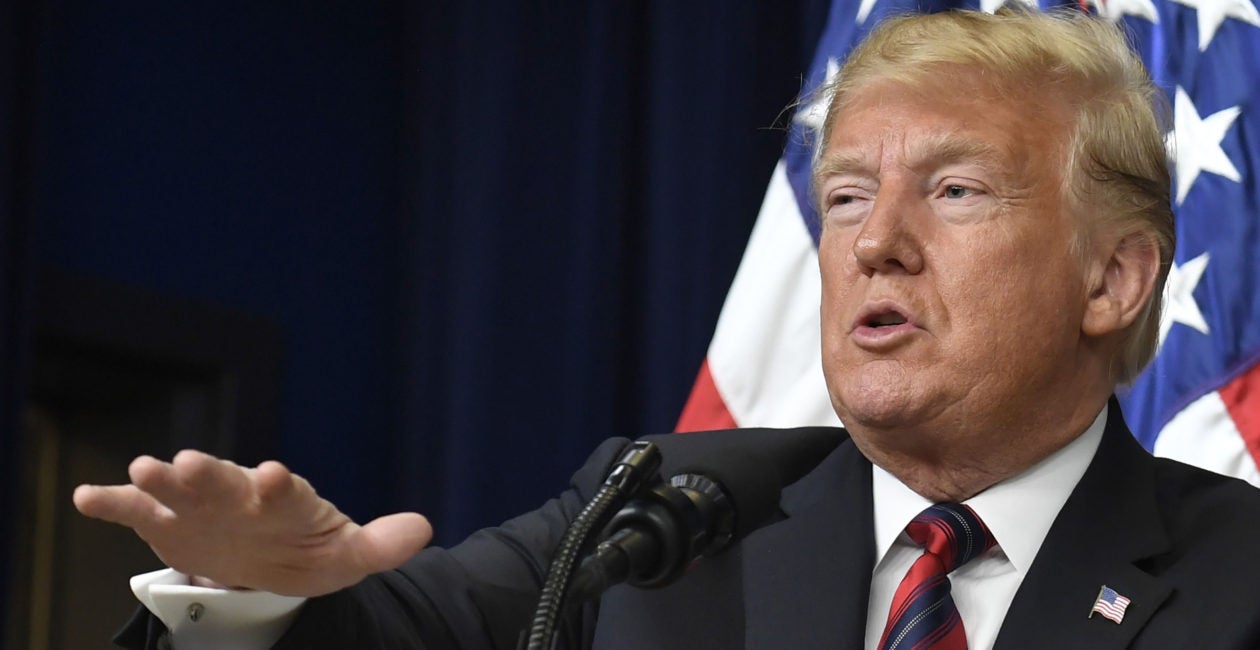
Trump’s New Rule Aims to Expand Health Coverage and Lower Costs


By Robert E. Moffit, Ph.D.  The Daily signal

The Trump administration just announced a major regulatory change, effective Jan. 1, 2020, that could significantly expand access to affordable health coverage and increase the choice of health plans, particularly among workers and their families in small businesses.
The proposed rule, jointly developed by the Department of Health and Human Services and the Treasury Department, would allow employer-sponsored health reimbursement accounts to fund the purchase of individual health insurance on a tax-free basis.
Today, workers and their families can use tax-free health reimbursement accounts to offset medical expenses, such as out-of-pocket medical costs. Under the new rule, workers and their families could use employer contributions to the accounts to buy health insurance on their own.
This opportunity is particularly valuable for workers employed by small business owners who cannot afford to offer standard group health insurance, but who could afford to help offset the premium costs of their employees’ individual coverage.
Treasury Department officials estimate that the new rule could encourage as many as 800,000 employers to sponsor health reimbursement accounts, or HRAs, to fund individual coverage for more than 10 million workers.
This relief is crucial, particularly for workers and their families in small businesses. With the enactment of Obamacare in 2010, the already fragile condition of health coverage among small businesses worsened. For little companies with fewer than 25 workers, the percentage of businesses offering health insurance fell from 44 percent in 2010 to just 30 percent in 2018.
The Trump rule has the potential not only to expand coverage, but also to increase employees’ choices in health plans.
Among small and midsize companies (with fewer than 200 employees), 81 percent offered only one health plan as of last year. No choice, just a “take it or leave it” option.
The Trump rule would open up new coverage opportunities for employers and employees.
The rule also has some ancillary benefits for workers already covered by traditional, employer-sponsored health insurance. It would permit employers to contribute up to $1,800 yearly (indexed to inflation) to reimburse workers for certain additional medical expenses, such as dental benefits, as well as premiums for short-term health insurance plans. Such less expensive plans are especially valuable for persons who are between jobs.
The impact of the Trump rule could prove genuinely transformational, if Congress would take the obvious next step: Adopt the reform policies outlined in the Health Care Choices Proposal, developed by a broad coalition of conservative health policy analysts.
That proposal would restore the bulk of regulatory authority over health insurance markets to the states, provide financial assistance for the poor and the sick, and enable persons in government programs to use public funding to enroll in a private health plan of their choice, if they wished to do so.
By enabling states to liberalize their health insurance markets, Congress could enable employees, using health reimbursement accounts as a vehicle for tax-free premium payments, to choose among a variety of new and innovative plans.
Today, enrollees in the broken individual and small group markets are trapped in artificially expensive Obamacare plans. They are punished with explosive deductibles, shrinking choices, and excessively narrow networks of doctors and hospitals.
Working together, Congress and the president could yet achieve the greater policy goal long supported by America’s most notable economists, including the late Milton Friedman: individual tax relief for the purchase of health insurance in a robust and competitive consumer-driven market.
That change could be, in the very best sense of the word, revolutionary.

Sunday, November 11, 2018

They're bidding for what?!!!


They're bidding for what?!
By Jason Stutman
Less than a month from today, the world will witness a modern David versus Goliath story play out.
On November 14th, David Beyerle, a communications engineer at Penn State University's IT department, will go toe to toe with a long list of major internet service providers (ISPs).
The ticket includes some of the most powerful carriers on the planet, namely Verizon Wireless, T-Mobile, and AT&T.
If you’re hoping for blood, you won’t find any in this fight. The battle will be overseen by the U.S. Federal Communications Commission (FCC) in an orderly fashion. No fists will be thrown and no stones will be flung. Nonetheless, it will be a fierce and hard-fought bout.
The prize won’t be anything you can touch or hold in your hands, yet it will be incredibly valuable to those who wish to wield it. Largely ignored by the mainstream media, the battle for something known as "millimeter waves" is one where investors will want a front-row seat.
 

Millimeter Waves: What Are They, and Why Are They So Valuable?
Millimeter waves, I have to admit, aren’t exactly a sexy topic. Most people have probably never even heard of millimeter waves before, but there’s a reason multibillion-dollar conglomerates are lining up to bid for them in a series of highly anticipated government auctions.
There’s a reason even underdogs like David Beyerle are hoping for a moonshot to get their hands on them...
Occupying the spectrum of frequencies between 24 GHz and 28 GHz, millimeter waves are much like any other form of wireless communication we’re already familiar with. Radio, cellular, and satellite all operate within specific ranges of wavelengths and frequencies.
Sending information through thin air may seem like magic to some, but the technology is based entirely in physics. Imperceptible to the human eye, electromagnetic waves of all shapes and sizes are constantly flowing through (or bouncing off) you at any given moment.
These waves all carry a set of physical properties that determine how they can be used for human benefit (or even harm). Frequency, wavelength, and photon energy ultimately determine what are known as propagation characteristics, or the way waves move through the atmosphere.
Again, this isn’t exactly enthralling information, but it absolutely matters. The point is that data doesn’t just travel through empty air; it rides physical waves, which are ultimately finite in supply.
This is why local television and radio broadcasters have unique “channel” assignments. Designating channels to specific broadcasters allows for multiple routes of communication without interference.
If we didn’t divvy up these channels, wireless communication would be as effective as a two-way highway with no lanes and no median. Hence the upcoming FCC auction for millimeter wave, a spectrum that will be crucial in the next generation of mobile communication, or 5G.
The Very Foundation of 5G
Without digging too deep into the details, millimeter waves operate within a range of relatively short wavelengths and high frequencies. This combination makes them incredibly effective at sending large amounts of data (high bandwidth) through the air to many different devices at once.
Now, high bandwidth on its own, of course, isn’t anything new. Infrared and optical wavelengths, in fact, can support higher data rates than millimeter waves can. These shorter wavelengths, however, are easily disrupted by the atmosphere. All it takes is a little bit of rain or fog to disrupt the signal, hence the use of optical fiber to prevent any interference.
Millimeter waves, though, are much more durable in the air. Not quite as durable as radio waves, mind you, but enough to get the job done.
In short, millimeter waves exist at the perfect intersection between distance and bandwidth. In the balancing act of the electromagnetic spectrum, they are essential to increasing the capacity of wireless communication as far as we need it today.
Needless to say, Verizon, AT&T, and T-Mobile have incredible incentive to control parts of the millimeter spectrum. Barring an act of God on behalf of David Beyerle, they’ll easily outbid the remaining competition when the FCC auctions kick off on November 14th.Why This All Matters to You
The millimeter wave spectrum may hold incredible value for ISPs, but it isn’t enough on its own. At the end of the day, these ISPs need access points to send and receive those signals.
Because millimeter waves can only travel so far, mobile carriers and their infrastructure partners have to tighten the net, so to speak. Instead of enormous cell towers every 20 miles or so, “small cell” towers are being deployed across the U.S. (and soon the entire world) in order to make full use of that millimeter spectrum.
In 2019 you’re going to start seeing these small cells popping up all over the place, if you haven’t already. They’ll be deployed on city sidewalks (perhaps disguised as lamp posts to conform to specific regulations), atop parking garages, and elsewhere.
All told, North American enterprises are expected to deploy a total of 400,000 small cells by the end of 2018, up from 292,000 in 2017. By 2020, that number is forecast to reach 552,000 small cells per year. By 2025, the number is expected to reach 849,000.
Needless to say this is going to be an explosive trend for the next half-decade and then some. For investors, it’s a potential gold mine, as the companies behind these small cell deployments have yet to reach the attention of the masses.
Frankly, we don’t expect that to last much longer, as 5G is less than a year away from becoming truly mainstream, so there’s a sense of urgency here I cannot stress enough.
My best is advice is to locate the top 5G stocks ASAP. You don't want to wait on this opportunity.

Sunday, November 4, 2018

Facebook Gets Hacked


Facebook Gets Hacked
Monica Savaglia PhotoBy Monica Savaglia
Written Oct. 16, 2018
Trust is a hard thing to gain, and it’s even harder to maintain.
However, when we sign up for and log into our favorite social media sites, we trust them with so much personal information. And not only our own personal information, but also information about our family and friends.
And we do this even though for some of us, trust is a very important thing to earn. We don’t go around sharing our personal information with complete strangers.
It takes a lot to earn my trust, for me to feel a sense of security that if I share something with someone, they’ll do everything in their power to protect that information.
Yet I still log into social networking sites like Facebook, my email account, and my Amazon account like it’s nothing. The last thing on my mind is that somehow that information is being compromised. I’m just going to those sites to find some entertainment or to purchase something I decided I needed.
Usually, I don’t think about the type of information I’m allowing Facebook to keep, believing that information won’t ever be harmed. Despite some potential risks from Facebook, I’ve still trusted the site. Not everyone is perfect, I’ve thought. I’ll just have to do my best to assist in protecting my information from potential hackers or attacks.
Well, it’s happened again. Facebook got hacked, and at least 30 million accounts have been compromised.
Can you still trust them?
Facebook Gets Hacked
A massive attack on Facebook surfaced last week. The hack could have impacted at least 30 million people and their Facebook accounts.
This past Friday, Facebook announced that a hack it detected could be a lot bigger than it originally thought. Facebook learned that personal information, including details about users' recent locations, phone numbers, and search histories, was taken by unidentified hackers.
In a blog post on Friday, Facebook said:
For 15 million people, attackers accessed two sets of information - name and contact details (phone number, email, or both, depending on what people had on their profiles). For 14 million people, the attackers accessed the same two sets of information, as well as other details people had on their pr…
There are a lot of details people can add to their Facebook profiles, including like their birthday, where they went to school, who they’re in a relationship with, etc. This is all information that users elect to share with Facebook and probably thought was safe.
Obviously, this announcement was something Facebook wishes it didn’t have to report, but it did. The company would have been risking a lot if it didn't report it.
Being a Facebook user means you agree to use your account with other third-party apps, which could put the information you share with those apps at risk, too. However, in this instance, Facebook assured the public that the hack didn’t affect any data in the company’s related services, including Messenger, Messenger Kids, Instagram, WhatsApp, Oculus, and developer accounts.
If you were one of the unfortunate accounts that was hacked, this is the information these hackers had access to: username, gender, locale/language, relationship status, religion, hometown, self-reported current city, birth date, device types used to access Facebook, education, work, the last 10 places you checked into or were tagged in, websites, people, or pages you follow, and the 15 most recent searches you made.
That’s a lot of information now at the disposal of these hackers.
 

The Aftermath
All this comes two weeks after an investigation that was taking place about the hack. Facebook mentioned that the hackers had taken advantage of three vulnerabilities in the “View As” feature on its site, which allows users to view their profile from other users’ perspectives.
Apparently the flaw was present since July 2017, but it wasn’t until September 14th that Facebook noticed suspicious activity. After discovering that suspicious activity, the company noticed the bugs and the attack those bugs created on September 25th.
Facebook’s vice president of product management, Guy Rosen, had this to say this past Friday:
With these access tokens an attacker could get into people’s accounts. We’re looking at approaches that could address this class of problem and, ensuring that we can catch them faster and minimize their impact.
The company says it hasn’t witnessed any evidence of stolen data because of this hack, which gives it more confidence in getting a deeper look at the data that was taken and the users that were affected. Facebook will continue to investigate the attack to identify any other abuse of the platform.
Any kind of attack or hack is significant to any platform, especially a social networking platform like Facebook that retains millions of users’ personal information... information a user might not even recognize as being compromised.
Again, we put a lot of trust in companies like Facebook. We trust them with copious amounts of our personal information, and we trust that they’ll inform us of all the details about any type of hack. Could you be the next victim?

Saturday, November 3, 2018

IBM Launches Food Supply Blockchain


IBM Launches Food Supply Blockchain
By John Butler
Written Oct. 15, 2018
Blockchain technology is becoming more commercial as time passes. This time, it’s reached our food supply chains.
IBM Food Trust has gone live for commercial use. The Trust’s blockchain technology is used to provide detailed supply-chain information on the users’ food products.
This isn’t IBM’s first blockchain product. Earlier this year, the company teamed up with Maersk to launch TradeLens, a blockchain used to track shipments around the world.
IBM has tested the Food Trust’s blockchain technology for a year and a half.
Several players have already signed up to use IBM Food Trust. These companies include Kroger, Tyson Foods, Nestle, and French retailer Carrefour.
After testing the product with pork and mangos earlier this year, even Walmart is on board. The superstore wants its suppliers to adopt IBM Food Trust by 2019.
Not only will IBM Food Trust provide a much-needed service, but its results will also affect blockchain technology’s commercial future.What Does the Food Trust Provide?
IBM’s Food Trust ledger permits its users several things related to the supply and shipping of food items.
First, a user can locate and monitor products going through every single step of the supply chain in seconds rather than days or weeks. By doing so in such a quick time, the spread and distribution of contaminated food is lessened. This quick tracking also lowers the amount of spoiled, wasted food being shipped.
Second, users can input, view, and operate data on IBM Food Trust’s blockchain.
Third, users can verify and exchange shipping certifications.
IBM charges a monthly subscription fee between $100 and $10,000 for use of the Food Trust technology.
What Will Be its Effects?
There will be several outcomes of IBM Food Trust going live. First, IBM Food Trust is one of the first blockchain networks of high proportion being used. If IBM Food Trust is successful, we will see many more companies adopting blockchain technology for their products.
Second, IBM Food Trust will save companies loads of time in keeping up with their items. Using IBM Food Trust, Walmart went from taking a week to track a food shipment to seconds.
Third, people’s health will benefit from IBM Food Trust’s presence. With the traceability and transparency IBM Food Trust provides, the number of people getting their hands on contaminated foods will decrease. Also, locating the contamination itself will become much more efficient.Walmart is using IBM Food Trust partly because of this. Earlier this year, the massive retailer was involved in the E. coli flare-up in contaminated lettuce. People were hospitalized during this outbreak, and some even lost their lives.
Using IBM Food Trust, Walmart will be able to trace its products at all stages of the food supply chain, from the farm to the store’s shelf. Walmart is currently using the technology to monitor over 20 produces, meats, and other perishables.
IBM Food Trust mitigating food contaminations is also going to save companies loads of money. Investigating a potential contamination and subsequently recalling the product is a very difficult and expensive process.
Just earlier this month, in the U.S., millions of pounds of beef were recalled due to a salmonella scare. IBM Food Trust will make it easier to investigate such claims, mitigating the time and money spent for resolution.
With IBM Food Trust, investigating contaminations and recalls will take minutes.
By now, it's not mere speculation that blockchain technology has proven its value in our everyday lives. It continues to show that it can solve problems for us in new, efficient ways. And IBM Food Trust’s development, use, and benefits prove just that.

Saturday, October 27, 2018

The myth of the eternal market bubble and why it is dead wrong


By Brandon Smith

Economic collapse is not an event — it is a process. I've been saying this since the 2008 crash, and I suppose I will keep saying until it burns into people's minds because I don't think that it is a widely understood concept. When alternative analysts talk about financial collapse, we are not talking about something that suddenly happens out of the blue, we are talking about an ongoing decline that occurs in stages. This decline is happening today in the U.S. and around the world, and it has been accelerating since the chaos of 2008. When we bring up the reality of collapse, we are referring to something that is happening now, not something waiting on the distant horizon.

The reason why some analysts can see it and others cannot is most likely due to the delusions surrounding market bubbles. These fiscal fantasy worlds are artificially created by central bank intervention and represent and attempt to mislead the populace on the true health of the system — for a limited time. Analysts with foresight see beyond the false data of the bubble to the core economic reality; other people see only the bubble and nothing else.
When it comes to stock markets, bond markets, forex markets and the general casino economy, much of the public has a terrible inability to look beyond the next month let alone the next year. If the markets look good now, the assumption is that they will always be good. If the central banks have intervened for the past 10 years, the assumption is they will intervene for the next 10 years.
There is no accounting for why the bubble exists in the first place. That is to say, most people including most economists do not consider that these bubbles serve a particular purpose for the banking elites and that this purpose has an expiration date. All bubbles collapse, and the reasons why they collapse are observable and predictable.
Still, the delusion persists that all this talk of "collapse" is simply "doom and gloom," an event that might happen many years or decades from now, but it's certainly not a threat taking place right in front of our faces. I attribute this fallacy to several popular misconceptions and propaganda arguments, and here they are in no particular order...

Fallacy #1: Central banks will continue to prop up markets indefinitely

The newest generation of market traders and economists were still in high school and college when the 2008 crash hit equities. For the entirety of their careers, they have seen nothing but an artificial economy supported by ongoing stimulus from central banks. They know nothing else and know little of history and thus they cannot fathom the possibility that central banks will one day pull the plug on their fiat life support.
The problem is that 10 years of stimulus is nothing more than a mild pause in the process of fiscal collapse of a civilization. In fact, the economic decline of nations could be represented as a series of imploding bubbles; each one lasting perhaps a decade, leading to more power and control for central banks and less prosperity for everyone else.
Recession history
Anyone examining the history of recessions and depressions in the U.S. since the inception of the Federal Reserve in 1913 can easily see a steady pattern of artificially inflated asset values followed by pervasive downturns that siphon wealth from the middle class. This wealth never returns in full. Each new downturn cripples the financial independence of the citizenry a little more, while international banks absorb more and more hard assets.
What mainstream economists don't seem to grasp is that central banks and international banks are always positioned to benefit from the crash of the bubbles they create. It is the reason why they inflated the bubbles from the very beginning. Central banks are not afraid to allow markets to plummet, they want markets to plummet. The banks simply want to be sure they are set up for optimum benefit when they do crash.

Fallacy #2: Central banks will never stop stimulus measures

I'm not sure why this fantasy persists despite all evidence to the contrary, but it does. Even today, I still receive letters from people arguing that the Fed will "never" end stimulus, never raise interest rates and never cut their balance sheet. Yet, this is exactly what is happening.
I heard the same arguments years ago in 2013 when I predicted that the Fed would in fact taper QE. I heard them in 2015 when I predicted that the Fed would raise interest rates. And I have heard them for the past year after I predicted the Fed would continue cutting assets from their balance sheet.
There are some people that might claim that there is no way for us to know if the Fed is actually cutting off stimulus to the economy because we have no way to audit their activities. While it is true that we do not have access to their legitimate records, only those they release to the public, we can see the affects that their policies produce. Meaning, it is obvious that the Fed is in fact cutting support to the markets given the behavior of those markets the past year.
Emerging market stocks are crashing as the Fed announces continuing balance sheet cuts. Treasury yields are spiking at historic rates and interest costs are rising on everything from car loans to mortgage loans as the Fed increases interest rates. Foreign investment in U.S. Treasurys (or lack of investment) has become a major point of concern because QE support for T-bonds is gone. Massive corporate debt loads not seen since 2007/2008 are becoming more expensive as interest rates expand.
This month Fed Chairman Jerome Powell ended all speculation on the matter when he indicated that the Fed would not only continue raising rates up to the neutral rate (where interest meets inflation), but that they could continue raising rates well beyond that. The blind faith based market is truly over.
All evidence suggests that fiscal tightening is indeed happening. Some people refuse to see it because their biases prevent them from doing so. Perhaps they are heavily invested in U.S. stocks and don't want to believe that the party is over. Perhaps they are incapable of admitting when they are wrong. It is hard to say. They argued for years that the Fed would never take the punch bowl away and they have been proven incorrect, but until they suffer direct consequences to their pocketbooks, they will not accept reality.

Fallacy #3: The Fed will return to stimulus Japanese-style

This is a very common claim designed to build false hope in markets. Bull rally hucksters and their followers has become so used to the easy life of "BTFD!" (Buy The F#$&ing Dip!) that they will apply any rationalization no matter how absurd in order to keep the fantasy going.
The claim is that because Japan's stimulus measures have been "successful" in keeping their markets afloat for at least two decades, this is the most likely strategy for the Fed and other central banks as well. What these people have not considered, though, is the speed at which Japan's central bank bought up assets versus the speed that the Fed bought up assets.
The Bank of Japan's balance sheet reached around $4.7 trillion (U.S.) at its peak, and as mentioned, this took decades of accumulation. The Fed's balance sheet hit $4.5 trillion in the span of only eight-10 years.
There is a point at which asset purchases and stimulus simply do not have the same effect on markets as they did when those purchases began. Debt starts to weigh heavily on further market gains over time. There is a reason why the Fed is choosing to implode the bubble now — time is running out and they want a controlled demolition rather that a crash with a mind of its own.
The printing press is not magical; the basic rules of economics and mathematics still apply.
I've also heard the argument that because US GDP is so much larger than Japan's, comparing their central bank balance sheets is "not practical." Meaning, the U.S. has a larger GDP, therefore the Fed should be able to increase its balance sheet much further than Japan has. This claim obviously relies on the notion that "GDP" as it is calculated today is an accurate measure of how much debt burden a nation can carry.
If you consider Japan's manufacturing capability alone, the U.S. with all it's outsourcing pales in comparison in terms of economic resiliency. If you also consider that every time the government spends tax dollars these programs are often added to GDP as a form of "production" (this includes Obamacare), then the idea of GDP becomes a joke. The point being, it does not matter how healthy a nation's GDP appears to be, their central bank can only create so much debt before it begins to drag down the core economy. The Fed has reached that limit.

Fallacy #4: The Fed Can Hyperinflate Markets Perpetually

This is the last-ditch delusion used by stock market addicts and disinformation peddlers to assert that the current bubble can and will be propped up for many years to come, even after the rest of the economy is in dire regression. It is based partially on historic examples of fiscal collapses that led to inflation. Sometimes this inflation flows directly into stock markets while the rest of the system sinks, due to investors looking for a safe haven and also due to central banks manipulating asset prices. This occurred in Weimar Germany during the hyperinflationary route of the 1920s, however, people who make this argument do not know the actual history of that collapse.
Germany did indeed see a considerable stock market rally just at the peak of the hyperinflationary crisis, but this period only lasted from 1924 to 1927. In 1927, the Federal Reserve, France and the German central bank intervened to deliberately crash the bubble. While central bankers today still assert the lie that the cause of this downturn was the gold standard, the truth is that it was central bank tightening of monetary policy into an already unstable economic environment that caused the crash.
An interesting article on this issue for those that would like a better historical reference is 'With a Bang, Not a Whimper: Pricking Germany's "Stock Market Bubble" in 1927 and the Slide into Depression' by Hans-Joachim Voth.
Does any of this sound familiar? It should. This is exactly what the Fed is doing today.
In the U.S. for the past decade we have already witnessed our period of inflation in stock prices. Now, the central bank is collapsing the bubble, just as they did in Weimar Germany, just as they did here in the U.S. during the Great Depression as Ben Bernanke admitted in 2002, just as they have done in every market bubble for the past century.
There is no eternal market bubble. There never will be. If not for the reason that economic fundamentals make it impossible, then for the reason that crashing these bubbles benefits globalists and banking elitists.
The goal? I believe the goal is to consolidate total power over production and labor using the deliberate institution of a poverty-based civilization. Beyond that, the goal is to make the populace perpetually desperate to the point that they are socially malleable. In order for the bankers to establish what they call their "New World Order," they need chaos to tenderize the masses, but they also have to be seen as saviors that deserve to be in a position of authority over the global economy. The need to create disasters so they can then ride in on their white horse and save us from those disasters.
Why would central banks continue to perpetuate market bubbles when the destruction of those bubbles gives them opportunities for greater power?

Tuesday, October 9, 2018

AFSCME 31 PAC contributes $767,800 to Madigan's Campaign


The American Federation of State, County and Municipal Employees Council 31 just handed a major political gift to Illinois House Speaker Mike Madigan – at the expense of union members.
According to the Illinois State Board of Elections, Council 31’s political action committee transferred $767,800 to Friends of Michael J. Madigan, the longtime speaker’s election committee, on Sept. 24. It’s the largest political contribution the union’s PAC has transferred to a politician’s personal election committee on record.
Records show that union dues directly contributed to that transfer.
Specifically, AFSCME Council 31’s political account – which is subcategorized as “membership dues” with the state board of elections – first transferred over $1.8 million to its PAC between Sept. 4 and Sept. 24. 
Then the PAC transferred $767,800 to Madigan’s election committee on Sept. 24.
That money will, in turn, be funneled to various Illinois House of Representatives candidates across the state.
This sort of political spending is business as usual for AFSCME. The PAC spent over $6.8 million between 2013 and 2017 on Illinois politics, according to records with the Illinois State Board of Elections.
As a chairman of multiple organizations, the top recipient of AFSCME’s political funding between 2013 and 2017 was Mike Madigan. Between his campaign committee (Friends of Michael J. Madigan), the Democratic Party of Illinois (which Madigan chairs) and Democratic Majority (which Madigan also chairs), the speaker took in over $541,000 from Council 31 over that time. Of course, this total does not include funds Council 31 sent directly to other Democratic lawmakers backed by the speaker, at his direction.
Filings also reveal that between 2013 and 2017, the PAC directed over $2,780,000 to the election committees of lawmakers currently sitting in the General Assembly. The majority of that spending – almost $2.7 million (96 percent) – was directed toward the election committees of Democrats. Filings show Republican election committees received only $101,000 during the same time period.
AFSCME Council 31 has claimed to be a “leading voice for working families in the state of Illinois.”
But its members may not agree with what that voice is saying – or with just how much of their money the union is using to be that voice.
AFSCME members upset by the union’s political spending do have recourse. They can stop their hard-earned money from being funneled to Madigan and his allies by resigning from the union and telling their employers to stop deducting dues from their paychecks.
For more information about opting out of paying money to the union, AFSCME members can visit leaveafscme.com.

Mailee Smith
Staff Attorney Illinois Policy

Sunday, September 9, 2018

After state edict, cities scramble on 5G rules


After state edict, cities scramble on 5G rules


    Springfield Mayor Jim Langfelder talks about 5G technology 

    Top of Form
    Bottom of Form
    Cities across Illinois are bracing for the next steps to get 5G cell phone technology in place, and the capital city could be among the first to get it.


    The 5G, or small cell, technology is expected to substantially boost cell phone data capacity.
    Earlier this year, Gov. Bruce Rauner signed a bill to bring about uniform standards for the deals local governments can make with telecommunications companies.

    Local governments may charge a one-time fee of $1,000, but they can't charge annual recurring rates, the law states.

    Stakeholders in Peoria, Naperville, Mount Prospect and Forest Park reportedly are some of the areas investigating the technology, and how to best regulate it locally under the new state law.


    "The City of Rockford recently adopted an ordinance governing the installation of small cell wireless facilities in anticipation of the expansion of 5G technology," Rockford Legal Director Nick Meyer said. "The City has not been contacted by any telecom companies at this time."


    Springfield Mayor Jim Langfelder said he didn’t like the bill because it took away local control, but the city will follow the law. However, with its publicly owned electric generation utility, he said Springfield is a bit unique.

    “You can put [small cell sites] on our poles but we still provide the infrastructure to provide the electricity for usage, so that’s the other piece of it where we’d be able to offset our costs where other municipalities don’t have the added cost that we do.”

    He said a deal between Springfield and AT&T could come together as early as next month.
    “Everybody wants 5G because of faster internet usage and things of that nature,” Langfelder said. “We’ve had discussions with AT&T and their implementation, and I think they’ve identified 50 sites within Springfield.”

    "We’re planning on deploying mobile 5G in a dozen U.S. cities this year.  We’ll update you when we’re ready to announce our 5G plans for cities in Illinois," AT&T spokesman Phil Hayes said. "The new small cell law in Illinois will help pave the way for 5G technology in the state."

    A July 20 statement online from the telecommunications company doesn’t list anywhere in Illinois as a possible spot. That statement names Charlotte and Raleigh, North Carolina, Dallas and Waco, Texas, and Atlanta, Georgia.

    “We’re deliberately launching with a mix of big and mid-sized cities,” the AT&T statement said. “One competitor recently boasted 'New York matters more than Waco' when discussing their future plans. We politely disagree – all Americans should have access to next-gen connectivity to avoid a new digital divide.”A spokesman for Verizon said the company announced it will launch 5G residential broadband service in four markets, none in Illinois.

    “To date, we’ve announced Indianapolis, Houston, Los Angeles and Sacramento,” Verizon spokesman Andy Choi said. “We're focused on launching those markets for the time being.

    Sprint “recently announced plans to launch its 5G mobile network in Atlanta, Chicago, Dallas, Houston, Kansas City, Los Angeles, New York City, Phoenix and Washington, D.C.” in the first half of 2019, according to a statement on the company's website. “Additional markets will be announced as Sprint continues the roll-out of its blazing-fast mobile 5G service." 


    Tags


Thursday, August 30, 2018

Is China Winning the 5G Race?


Is China Winning the 5G Race?
By Monica Savaglia
Written Aug. 14, 2018
Is China winning the 5G race?
This technology is fairly new, so it might be too early to say China is winning the 5G race, but the country is very focused on becoming a leader in the industry.
According to a study released by Deloitte, since 2015, China has built about 350,000 cell sites. The U.S., meanwhile, has built around 30,000.
China has been working diligently to install new wireless sites, which need to be placed on either lampposts or utility poles in densely populated areas.
China is so focused on expanding 5G throughout the country that it’s making a significant economic commitment to the technology. Its five-year economic plan, which runs through 2020, is calling for $400 billion in spending on 5G investment.
The Deloitte report said, “Consequently, China and other countries may be creating 5G networks, which will ultimately be used to power self-driving cars, virtual reality, and smart cities.”
5G networks will unlock endless possibilities from technology and enhance any smart devices we already use.
Obviously, the first country that successfully sets up 5G networks will have a massive lead over other countries working toward 5G adoption. The Deloitte report mentioned “first-adopter countries embracing 5G could sustain more than a decade of competitive advantage.” And right now, China is dominating with its installation of new wireless sites, which means it has the competitive advantage. 
Two other important factors in the 5G race are research and development and the ability for the government to quickly allocate additional radio frequencies to wireless companies. 5G needs more bandwidth, and the only way to achieve it is with these radio frequencies.
The time, money, and energy devoted to research and development in new technologies is always key when it comes to becoming a global leader in a certain industry or tech. China is devoting its time, money, and energy to 5G, and it’s already paying off.China Mobile Hong Kong is Completing 5G Network Tests
China Mobile Hong Kong continues to work on 5G Wi-Fi. It recently announced that it is completing 5G network tests and is succeeding in connecting non-5G devices and computers to its Wi-FI hotspots.
5G-capable smartphones are still a year or more away from being fully accessible; however, devices will have the opportunity to connect using 5G Wi-Fi hotspots. China Mobile Hong Kong believes it will be ready to provide full services once rollout is complete.
The company said:
China Mobile Hong Kong has planned to build a 28GHz 5G network in selected locations by year end to conduct a field test...
The company is also working with partners to develop smart city-related applications such as smart lamp posts to be better equipped for 5G network construction and application development.
This is just one example of the dedication China and its tech companies have to 5G.
China Mobile Hong Kong continues to heavily invest in 5G research and development. It recently signed agreements with HTC to develop a solid 5G infrastructure and compatible 5G devices.
The realization that this industry is going to bring in huge profits and economic benefits is going to outweigh the current costs to deploy the technology. It's all going to be worth it in the end.Does the U.S. Have a Chance?
Despite what is happening right now, the U.S. isn’t sitting back and watching China dominate the 5G market. The U.S. is making its own strides to become a world leader of the next-generation technology.
Last month, the U.S Federal Communications Commission (FCC) was advised by the Executive Branch to deny China Mobile entry. The Executive Branch made this decision based on “substantial and unacceptable risk to U.S. law enforcement and foreign intelligence collection.”
The CIA, FBI, and NSA told Americans in February that they shouldn’t use products from Huawei and ZTE because of the potential security risks with their devices. However, these agencies don’t have any evidence to back up these claims, but warning Americans that there might be some risk if they purchase devices by those companies could help reduce the market share of the companies, and ultimately China’s lead in the 5G race.
Additionally, the Trump administration has been contemplating creating a set of standards for a nationwide 5G mobile network to prevent China from dominating the industry. The threat is real. But it doesn’t seem like the U.S. is entirely afraid of its place in the industry.
The U.S. is gaining speed when it comes to its research for 5G. In fact, two industry giants, Intel and Qualcomm, are hard at work researching and developing 5G technologies, so the U.S. will have a chance to win the 5G race in the same way it became a leader in 4G technologies.
But as of right now, China is in the lead. A report from CTIA, a trade association for the U.S. wireless industry, said China was the country most prepared to deploy 5G networks. South Korea was second, the U.S. was third, and Japan was fourth.
It’s going to be an interesting race to 5G. I know I’m going to be paying very close attention to it!
If you want to profit no matter which nation wins the race, there's a way to do that. Click here for my colleague Jason Stutman's presentation on the companies set to dominate the 5G revolution.


Monica Savaglia is Wealth Daily’s IPO specialist. With passion and knowledge, she wants to open up the world of IPOs and their long-term potential to everyday investors. She does this through her newsletter IPO Authority, a one-stop resource for everything IPO. She also contributes regularly to the Wealth Daily e-letter. To learn more about Monica, click here.