In this age of machines and ETFs, there just aren't slow grinds to the downside. Instead, we get gut-wrenching plunges that push indicators from extremely bullish to extremely bearish in a matter of two or three days...
Remember that VIX crash back in February, when the S&P 500 corrected by 13%? It actually started during the last couple days of January. The high for the S&P 500 came on January 26. And it didn't really get back to rally mode until May 3. But the bulk came during just three sessions between February 2 and February 8.
If you blinked, you missed it.
The machines make sure selling is relentless. And ETFs make sure that when the selling starts, it's everything.
It's a pretty wicked combination. It looks very much like panic selling. Though we really don't how it will look if/when some real panic selling hits. If we can get 800–1,000-point drops on the Dow for no good reason, does that mean we'll see 3,000-point drops if we get another 2008–9 financial crisis?
The best thing any of us can do to navigate these types of sell-offs is know what's causing investors to suddenly hit the sell button. Knowledge is the best antidote for fear.
So that's where we're going today: to take a look at what crushed the Dow 1,400 points in two days last week.
Interest Rates or Trade War?
I've seen a lot of commentary that investors are really worried about interest rates going higher. You've probably heard the supposed cause-and-effect relationship between the Fed hiking rates and the economy hitting recession. But let me tell you: Rising interest rates do not cause recessions. It's the bad decisions that get made when rates are low that eventually cause recessions.
Did Greenspan's rate hikes cause the financial crisis? Of course not. A 500-point rate hike might've popped the internet bubble, but it was 9/11 that really hit the economy.
So now the Fed has hiked interest rates to 2.25%... and people are worried that's going to bring it all crashing down? Please, just stop. Rates were 5.25% before the financial crisis. And the hike that broke the internet bubble took rates to 6.5%.
Of course, it's a relative thing, how much rates have gone up and how fast. You'd be hard-pressed to say rates have risen a lot, or fast.
But still, today's first-time homebuyers might've only been in middle school the last time rates were "high." All they know is a mortgage is more expensive today than it was a year ago. Same with a new car payment. And that's kind of the point: Make money more expensive, and people tend to borrow and spend less.
On the corporate front, it is likely that higher rates will affect stock buybacks. Companies have been buying back about $1 trillion of their own stock for the past six years. And that's been a solid source of upside for prices. Problem is, they've borrowed to do it. Not because they don't have the cash — they do. But when rates are so low, it makes sense to borrow at the low rate and keep the cash on the books and invested.
Companies aren't likely to start spending their cash, either. The most obvious response to higher rates is simply to borrow less. Which means fewer buybacks. But of course, fewer corporate buybacks aren't going to make the U.S. economy slow down...
When it comes to a slowing economy and the potential for recession, we have to look to what could kick off the vicious cycle. Less spending → lower profits → corporate layoffs → less spending.
The answer is tariffs.
The Ford Problem
Last week was not great for Ford. The carmaker had to admit that China sales were down over 40%, that its annual profit would be $1 billion lower than last year, and that it was going to restructure its workforce and layoff thousands. Hello, vicious cycle!
Now, Ford has some issues of its own that are contributing. But pretty much all automakers saw their sales decline in China for the last three months. It's the tariffs and trade tensions.
China's stock market has been selling off since February, when the first tariffs were announced. The Chinese economy is weakening.
You could say this proves that the tariffs are working, that China will be forced to negotiate. But tariffs will hurt the U.S., too. And Europe. Because the bottom line is that China is now an end market for Ford, for Apple, for Harley-Davidson, for Nike, for Starbucks...
And it's also the most important end market in the world due to the combination of size and growth. Now, like with Ford, major corporations are at risk of joining the vicious cycle that starts with slowing sales in China.
I think the risk of recession in the next months is high. And it's a virtual certainty if there's no trade deal with China.
You know the financial media will run around like headless chickens, shrieking, "Trade war! Trade war!" And given the elevated valuations, the downside for stocks could be pretty decent. But ultimately, any tariff-related recession ought to be pretty mild. So here's the game plan...
Check through your stocks, pinpoint the ones that aren't great, and get rid of them. Keep the great ones. And start putting some cash aside to buy more great stocks when they get cheap. That's it. Pretty simple. But as Buffett said, the most important trait for an investor is patience.
Large numbers of migrants from various countries–including Brazil and even as far as China & India–are traveling through Central America to the United States.
Judicial Watch is currently reporting on the ground in Guatemala.
Young Angry Men & Gangbangers March Towards U.S. Yelling “Vamos Para Allá Trump!”
From Judicial Watch
Besides gang members and mobs of young angry men, the Central American caravan making its way into the United States also consists of Africans, Bangladeshis, Sri Lankans and Indians.
Judicial Watch is covering the crisis from the Guatemalan-Honduran border this week and observed that the popular mainstream media narrative of desperate migrants—many of them women and children—seeking a better life is hardly accurate.
Guatemalan intelligence officials confirmed that the caravan that originated in the northern Honduran city of San Pedro Sula includes a multitude of Special Interest Aliens (SIA) from the countries listed above as well as other criminal elements and gang members.
There are also large groups of men, some with criminal histories, aggressively demanding that the U.S. take them in. During a visit to the Guatemalan town of Chiquimula, about 35 miles from the Honduran border, Judicial Watch encountered a rowdy group of about 600 men, ages 17 to about 40, marching north on a narrow two-lane highway.
Among them was a 40-year-old Honduran man who previously lived in the United States for decades and got deported. His English was quite good, and he said his kids and girlfriend live in the U.S. Another man in his 30s contradicted media reports that caravan participants are fleeing violence and fear for their life.
“We’re not scared,” he said waving his index finger as others around him nodded in agreement. “We’re going to the United States to get jobs.” Others chanted “vamos para allá Trump!” (We’re coming Trump) as they clenched their fists in the air. “We need money and food,” said a 29-year-old man who made the trek with his 21-year-old brother.
All of the migrants interviewed by Judicial Watch repeated the same rehearsed line when asked who organized the caravan, insisting it was a spontaneous event even though there were clearly organizers shouting instructions in Spanish and putting select persons in front of cameras for interviews.
A few claimed they heard about it on local news in Honduras. All of them said the caravan was not about politics but rather poverty. “I just want to get back to the U.S.,” said a 32-year-old man who admitted he has been deported from the U.S. twice. “We are all just looking for work.” The group radiated a sense of empowerment. One marcher, who appeared to be in his late teens, yelled “you go live in Honduras and see what it’s like!”
Honduran President Juan Orlando Hernández, a conservative, said in a local newspaper report that leftist interests seeking to destabilize the country are manipulating migrants. Women and children are being used without regard to the risks to their lives, Hernández said.
“The irregular mobilization was organized for political reasons to negatively affect the governance and image of Honduras and to destabilize the peace of neighboring countries,” the president said, adding that many have returned to the country after realizing they’ve been fooled.
Guatemala is overwhelmed with the sudden onslaught and immigration officials confirmed 1,700 migrants have been returned to Honduras on buses. The first wave of migrants totaled about 4,000, according to Guatemalan government sources, followed by a second, less organized group of about 2,000.
The impoverished Central American nation needs help, including logistical, communications and civil affairs support to stop the human caravans. “There are only so many resources we can dedicate to this,” said Guatemalan Secretary of Strategic Intelligence Mario Duarte. Guatemalans are getting robbed and crimes are being committed by the people in the caravans, Duarte said.
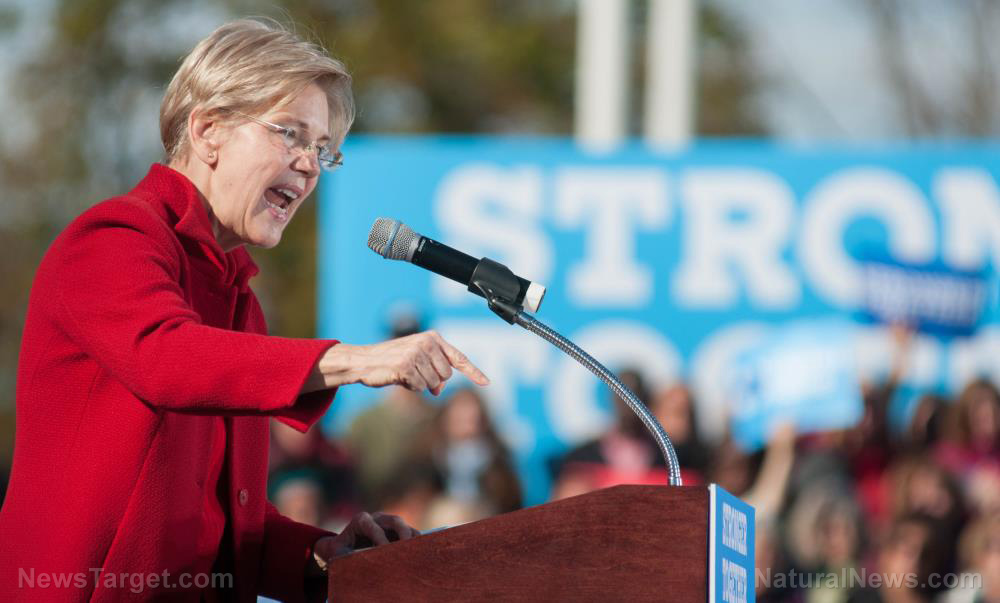
(Natural News) Democrat race hoaxer Elizabeth Warren wormed her way through Harvard by falsely claiming to be Native American. In 1997, the Fordham Law Review made her the poster child of successful “women of color” even though she’s white. Warren is widely expected to make a run for the presidency in 2020, so the entire fake news media is now trying desperately to clean up her history by finding some evidence that she might have Native American ancestry.
Today, Elizabeth Warren released a so-called “DNA study” that had absolutely no independent chain of custody of her DNA sample, meaning the entire thing could have been easily faked by using someone else’s saliva or tissue sample. Even then, the DNA test revealed that she could be as little as 1/1024th Native America, or about .0976% “Indian.” This number comes from the Associated Press, which had to issue a correction because they got the math wrong in their first version of their report, which desperately tried to claim the DNA test proves Warren correct about her claims of being “Native American.”
Yet most Native American tribes require individuals to be, at minimum, 1/8th Native American in order to qualify. Some tribes require as little as 1/16th. There is no tribe in America that allows inclusion for people who are 1/1024th Native America. The entire left-wing media has deliberately neglected to mention this critical point, claiming that as long as Warren has at least one molecule of Native American blood in her body, then she’s obviously a “woman of color.” (Notably, in a similar story, a biological man who pretends to be a woman just won the women’s cycling championship. Feminists applauded the defeat of women by a man claiming to be a woman. This is the new Left, where a man is a woman, and a white woman is an Indian.)
The average white American has twice as much Native American blood as Elizabeth Warren
Furthermore, according to a 2014 story from the New York Times, the typical “white” American is .18% Native American, .19% African and 98.6% European.
This means the average white American has twice as much Native American blood as Elizabeth Warren.
In other words, Elizabeth Warren’s DNA test merely confirms she’s another white American. Yet the entire left-wing media is claiming her tests prove she’s Native American.
If Elizabeth Warren is Native American, then so is nearly every white person in America, rendering the entire “Native American” designation meaningless. But the Left doesn’t want any rules to be consistently applied. In the same way Hillary Clinton gets a special pass on criminal obstruction and destruction of evidence, Elizabeth Warren receives special treatment on her ancestry that isn’t granted to anyone else.
According to this logic, nearly EVERY woman in America is a “woman of color”
If Elizabeth Warren is a “woman of color,” as has been widely touted, then that must also mean nearly every white woman in America is a “woman of color.”
The same deranged Left, in other words, that now claims Elizabeth Warren is Native American — even though she’s white — also claims that all white people are bad and should be removed from power. Amazingly, such demands never apply to white women like Elizabeth Warren, who receives special protection from the lying left-wing media by claiming she’s a “woman of color” even though she’s whiter than most white people.
Ultimately, the Left is all about the complete obliteration of logic and reason, which is why Leftists are also out to destroy all science and replace it with left-wing hoaxes like transgenderism and climate change. If you believe a biological man can magically transform into a woman, then you might also believe that Elizabeth Warren is a Native American when, in truth, she’s a cheater and liar who falsely claimed to be Indian in order to gain a “victimhood” advantage over her classmates.
Like all Democrat politicians, in other words, Elizabeth Warren is a liar and a cheat.
Trust is a hard thing to gain, and it’s even harder to maintain.
However, when we sign up for and log into our favorite social media sites, we trust them with so much personal information. And not only our own personal information, but also information about our family and friends.
And we do this even though for some of us, trust is a very important thing to earn. We don’t go around sharing our personal information with complete strangers.
It takes a lot to earn my trust, for me to feel a sense of security that if I share something with someone, they’ll do everything in their power to protect that information.
Yet I still log into social networking sites like Facebook, my email account, and my Amazon account like it’s nothing. The last thing on my mind is that somehow that information is being compromised. I’m just going to those sites to find some entertainment or to purchase something I decided I needed.
Usually, I don’t think about the type of information I’m allowing Facebook to keep, believing that information won’t ever be harmed. Despite some potential risks from Facebook, I’ve still trusted the site. Not everyone is perfect, I’ve thought. I’ll just have to do my best to assist in protecting my information from potential hackers or attacks.
Well, it’s happened again. Facebook got hacked, and at least 30 million accounts have been compromised.
Can you still trust them?
Facebook Gets Hacked
A massive attack on Facebook surfaced last week. The hack could have impacted at least 30 million people and their Facebook accounts.
This past Friday, Facebook announced that a hack it detected could be a lot bigger than it originally thought. Facebook learned that personal information, including details about users' recent locations, phone numbers, and search histories, was taken by unidentified hackers.
In a blog post on Friday, Facebook said:
For 15 million people, attackers accessed two sets of information - name and contact details (phone number, email, or both, depending on what people had on their profiles). For 14 million people, the attackers accessed the same two sets of information, as well as other details people had on their pr…
There are a lot of details people can add to their Facebook profiles, including like their birthday, where they went to school, who they’re in a relationship with, etc. This is all information that users elect to share with Facebook and probably thought was safe.
Obviously, this announcement was something Facebook wishes it didn’t have to report, but it did. The company would have been risking a lot if it didn't report it.
Being a Facebook user means you agree to use your account with other third-party apps, which could put the information you share with those apps at risk, too. However, in this instance, Facebook assured the public that the hack didn’t affect any data in the company’s related services, including Messenger, Messenger Kids, Instagram, WhatsApp, Oculus, and developer accounts.
If you were one of the unfortunate accounts that was hacked, this is the information these hackers had access to: username, gender, locale/language, relationship status, religion, hometown, self-reported current city, birth date, device types used to access Facebook, education, work, the last 10 places you checked into or were tagged in, websites, people, or pages you follow, and the 15 most recent searches you made.
That’s a lot of information now at the disposal of these hackers.
The Aftermath
All this comes two weeks after an investigation that was taking place about the hack. Facebook mentioned that the hackers had taken advantage of three vulnerabilities in the “View As” feature on its site, which allows users to view their profile from other users’ perspectives.
Apparently the flaw was present since July 2017, but it wasn’t until September 14th that Facebook noticed suspicious activity. After discovering that suspicious activity, the company noticed the bugs and the attack those bugs created on September 25th.
Facebook’s vice president of product management, Guy Rosen, had this to say this past Friday:
With these access tokens an attacker could get into people’s accounts. We’re looking at approaches that could address this class of problem and, ensuring that we can catch them faster and minimize their impact.
The company says it hasn’t witnessed any evidence of stolen data because of this hack, which gives it more confidence in getting a deeper look at the data that was taken and the users that were affected. Facebook will continue to investigate the attack to identify any other abuse of the platform.
Any kind of attack or hack is significant to any platform, especially a social networking platform like Facebook that retains millions of users’ personal information... information a user might not even recognize as being compromised.
Again, we put a lot of trust in companies like Facebook. We trust them with copious amounts of our personal information, and we trust that they’ll inform us of all the details about any type of hack. Could you be the next victim?
By Michael Liedtke - Associated Press - Thursday, October 18, 2018
MENLO PARK, Calif. (AP) — In an otherwise innocuous part of Facebook’s expansive Silicon Valley campus, a locked door bears a taped-on sign that reads “War Room.” Behind the door lies a nerve center the social network has set up to combat fake accounts and bogus news stories ahead of upcoming elections.
Inside the room are dozens of employees staring intently at their monitors while data streams across giant dashboards. On the walls are posters of the sort Facebook frequently uses to caution or exhort its employees. One reads, “Nothing at Facebook is somebody else’s problem.”
That motto might strike some as ironic, given that the war room was created to counter threats that almost no one at the company, least of all CEO Mark Zuckerberg, took seriously just two years ago - and which the company’s critics now believe pose a threat to democracy.
Days after President Donald Trump’s surprise victory, Zuckerberg brushed off assertions that the outcome had been influenced by fictional news stories on Facebook, calling the idea “pretty crazy.”
But Facebook’s blase attitude shifted as criticism of the company mounted in Congress and elsewhere. Later that year, it acknowledged having run thousands of ads promoting false information placed by Russian agents. Zuckerberg eventually made fixing Facebook his personal challenge for 2018.
The war room is a major part of Facebook’s ongoing repairs. Its technology draws upon the artificial-intelligence system Facebook has been using to help identify “inauthentic” posts and user behavior. Facebookprovided a tightly controlled glimpse at its war room to The Associated Press and other media ahead of the second round of presidential elections in Brazil on Oct. 28 and the U.S. midterm elections on Nov. 6.
“There is no substitute for physical, real-world interaction,” said Samidh Chakrabarti, Facebook’s director of elections and civic engagement. “The primary thing we have learned is just how effective it is to have people in the same room all together.”
More than 20 different teams now coordinate the efforts of more than 20,000 people - mostly contractors - devoted to blocking fake accounts and fictional news and stopping other abuses on Facebook and its other services. As part of the crackdown, Facebook also has hired fact checkers, including The Associated Press, to vet new stories posted on its social network.
Facebook credits its war room and other stepped-up patrolling efforts for booting 1.3 billion fake accounts over the past year and jettisoning hundreds of pages set up by foreign governments and other agents looking to create mischief.
But it remains unclear whether Facebook is doing enough, said Angelo Carusone, president of Media Matters For America, a liberal group that monitors misinformation. He noted that the sensational themes distributed in fictional news stories can be highly effective at keeping people “engaged” on Facebook - which in turn makes it possible to sell more of the ads that generate most of Facebook’s revenue.
“What they are doing so far seems to be more about trying to prevent another public relations disaster and less so about putting in meaningful solutions to the problem,” Carusone said. “On balance, I would say they that are still way off.”
Facebook disagrees with that assessment, although its efforts are still a work in progress. Chakrabarti, for instance, acknowledged that some “bugs” prevented Facebook from taking some unspecified actions to prevent manipulation efforts in the first round of Brazil’s presidential election earlier this month. He declined to elaborate.
The war room is currently focused on Brazil’s next round of elections and upcoming U.S. midterms. Large U.S. and Brazilian flags hang on opposing walls and clocks show the time in both countries.
Facebook declined to let the media scrutinize the computer screens in front of the employees, and required reporters to refrain from mentioning some of the equipment inside the war room, calling it “proprietary information.” While on duty, war-room workers are only allowed to leave the room for short bathroom breaks or to grab food to eat at their desks.
Although no final decisions have been made, the war room is likely to become a permanent fixture at Facebook, said Katie Harbath, Facebook’s director of global politics and government outreach.
“It is a constant arms race,” she said. “This is our new normal.”
Blockchain technology is becoming more commercial as time passes. This time, it’s reached our food supply chains.
IBM Food Trust has gone live for commercial use. The Trust’s blockchain technology is used to provide detailed supply-chain information on the users’ food products.
This isn’t IBM’s first blockchain product. Earlier this year, the company teamed up with Maersk to launch TradeLens, a blockchain used to track shipments around the world.
IBM has tested the Food Trust’s blockchain technology for a year and a half.
Several players have already signed up to use IBM Food Trust. These companies include Kroger, Tyson Foods, Nestle, and French retailer Carrefour.
After testing the product with pork and mangos earlier this year, even Walmart is on board. The superstore wants its suppliers to adopt IBM Food Trust by 2019.
Not only will IBM Food Trust provide a much-needed service, but its results will also affect blockchain technology’s commercial future.What Does the Food Trust Provide?
IBM’s Food Trust ledger permits its users several things related to the supply and shipping of food items.
First, a user can locate and monitor products going through every single step of the supply chain in seconds rather than days or weeks. By doing so in such a quick time, the spread and distribution of contaminated food is lessened. This quick tracking also lowers the amount of spoiled, wasted food being shipped.
Second, users can input, view, and operate data on IBM Food Trust’s blockchain.
Third, users can verify and exchange shipping certifications.
IBM charges a monthly subscription fee between $100 and $10,000 for use of the Food Trust technology.
What Will Be its Effects?
There will be several outcomes of IBM Food Trust going live. First, IBM Food Trust is one of the first blockchain networks of high proportion being used. If IBM Food Trust is successful, we will see many more companies adopting blockchain technology for their products.
Second, IBM Food Trust will save companies loads of time in keeping up with their items. Using IBM Food Trust, Walmart went from taking a week to track a food shipment to seconds.
Third, people’s health will benefit from IBM Food Trust’s presence. With the traceability and transparency IBM Food Trust provides, the number of people getting their hands on contaminated foods will decrease. Also, locating the contamination itself will become much more efficient.Walmart is using IBM Food Trust partly because of this. Earlier this year, the massive retailer was involved in the E. coli flare-up in contaminated lettuce. People were hospitalized during this outbreak, and some even lost their lives.
Using IBM Food Trust, Walmart will be able to trace its products at all stages of the food supply chain, from the farm to the store’s shelf. Walmart is currently using the technology to monitor over 20 produces, meats, and other perishables.
IBM Food Trust mitigating food contaminations is also going to save companies loads of money. Investigating a potential contamination and subsequently recalling the product is a very difficult and expensive process.
Just earlier this month, in the U.S., millions of pounds of beef were recalled due to a salmonella scare. IBM Food Trust will make it easier to investigate such claims, mitigating the time and money spent for resolution.
With IBM Food Trust, investigating contaminations and recalls will take minutes.
By now, it's not mere speculation that blockchain technology has proven its value in our everyday lives. It continues to show that it can solve problems for us in new, efficient ways. And IBM Food Trust’s development, use, and benefits prove just that.